
Every founder hits the same wall eventually: too many tabs open, too many subscriptions, and still no clear picture of what’s actually working. You didn’t start a company to spend your evenings comparing pricing pages. You started it to build something people want, and yet half your week disappears into deciding which app should own which piece of your workflow.
That’s exactly where growth navigate startup tools come in. This guide walks you through what these tools actually do, how to pick the right ones for your stage, and how to avoid the budget traps that quietly sink early teams. You’ll also see how growth navigate thinking applies to real decisions, not just theory. Stick with it, and by the end you’ll know exactly how to build a stack that grows with you instead of against you.
Growth Navigate Startup Tools
Startups don’t fail because founders lack ambition. They fail because execution slips through the cracks that better systems would have caught. That’s the whole premise behind growth navigate startup tools — they exist to close those gaps before they become expensive.
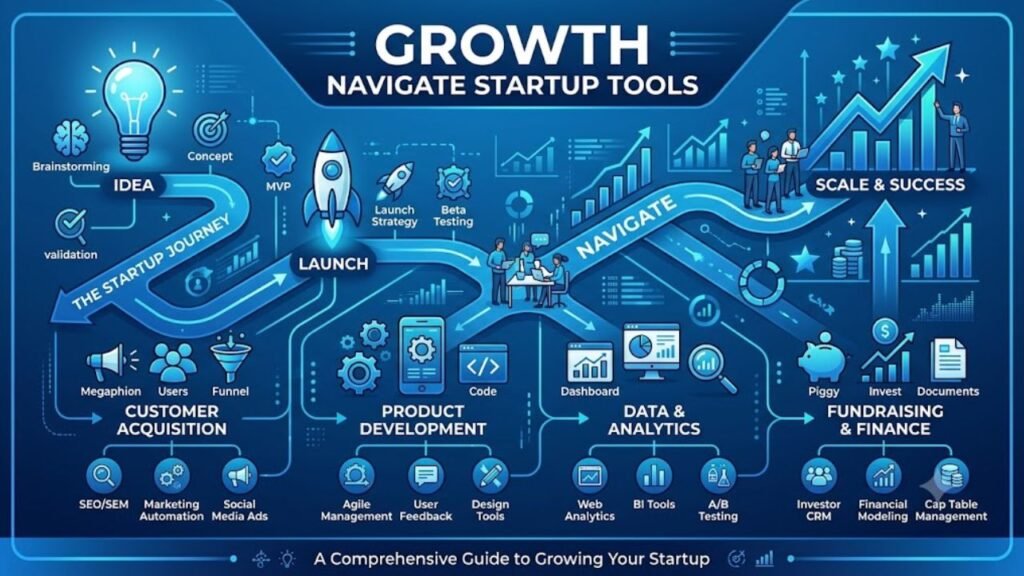
Think of a stack as connective tissue for a small team. It links your marketing efforts to your sales pipeline, your sales pipeline to your finances, and your finances to the decisions you make next quarter. Done right, five people can operate with the coordination of a team three times the size.
A few numbers make the case for taking this seriously:
- Cloud-based software now runs the majority of early-stage operations, replacing spreadsheets almost entirely
- Teams using a connected stack report fewer missed follow-ups and faster decision cycles
- Founders who track metrics weekly close funding rounds with more confidence
- Startup tools that integrate natively save hours of manual data entry every month
- Companies that review their stack quarterly spend less on software overall
What Is the Best Startup Tool Stack for a Small Team?
This is one of the most searched questions among early founders, and the honest answer is: it depends less on the tools themselves and more on how few of them you can get away with using well.
What Growth Navigate Startup Tools Really Are
In plain terms, these are the digital systems that quietly run the daily operations of a young company. They swap out manual tracking, scattered spreadsheets, and endless email chains for platforms that pull live data into one place and automate the repetitive parts of your job.
A five-person startup faces a different set of problems than a five-hundred-person company. Budgets are tighter. Each hire has to wear four hats instead of one. Growth navigate startup tools exist to close that gap, giving a lean team the visibility and speed that larger competitors take for granted.
- Automation handles the repetitive tasks nobody wants to do manually
- Dashboards replace guesswork with a single source of truth
- Integrations let your apps talk to each other without extra effort
- Analytics turn raw clicks and signups into decisions you can act on
- Collaboration tools keep remote and hybrid teams aligned in real time
Your stack works best when you think of it as the operational backbone of the business, not a random pile of subscriptions you added because someone mentioned them on a podcast.
Why the Right Tools Matter So Much
Software decisions used to sit with the IT department. Now they sit at the center of strategy, because most startups don’t fail on the idea — they fail on execution.
A well-chosen stack solves three problems at once. It speeds up how fast you can find and convert customers. It removes internal friction so people aren’t stuck waiting on updates or status meetings. And it replaces gut-feel decisions with actual evidence pulled straight from your data.
| Problem | What Good Tools Fix | Result |
| Slow customer acquisition | Clear channel-level data | Lower cost per customer |
| Internal miscommunication | Shared dashboards and task tracking | Fewer missed deadlines |
| Guesswork decisions | Live analytics and reporting | Faster, evidence-based choices |
| Manual busywork | Workflow automation | More hours for actual growth work |
Founders who run on clean, current data tend to move faster and burn less cash getting there. That’s not a coincidence — it’s the entire point of building a proper growth navigate system in the first place.
The Core Categories Every Startup Stack Needs
Before you shop for specific products, it helps to understand the jobs those products are supposed to do. A complete stack usually covers six categories, and skipping any one of them tends to create a blind spot later.
- Customer relationship management (CRM) keeps every lead, deal, and conversation in a single, searchable place
- Project management coordinates who’s doing what without relying on memory or Slack scroll-back
- Analytics and product intelligence show how people actually use what you built
- Marketing automation runs campaigns and follow-ups without someone manually hitting send
- Workflow automation connects your other tools so data moves on its own
- Finance and accounting tracks burn rate and runway, which is what actually keeps the lights on
How Many Tools Does a Startup Really Need to Grow?
Fewer than most founders assume. A lean, well-connected stack often runs on one tool per category above — six or seven total — rather than the fifteen-plus subscriptions many teams accumulate by accident.
The Best Growth Navigate Startup Tools by Job
Once you know the categories, matching a tool to each job gets much simpler. Here’s how most lean teams approach it, organized by function rather than brand loyalty.
| Job | Good Starting Option | Why It Fits Early Teams |
| CRM and sales | A free-tier CRM with pipeline views | Keeps leads visible without upfront cost |
| Team communication | Channel-based messaging app | Cuts down on internal email |
| Project tracking | All-in-one workspace | Combines docs, boards, and notes |
| Visual planning | Online whiteboard | Useful for sprint planning and brainstorms |
| Web and product analytics | Free analytics suite | Tracks visitor and user behavior |
| Automation | No-code connector tool | Links apps without a developer |
- Match the job first, then compare specific products against your budget
- Start on free tiers wherever one is offered, and upgrade only when you hit real limits
- Check integrations before committing to anything that touches customer data
- Avoid duplicate categories — one CRM, not three half-used ones
- Revisit your choices every quarter as your needs shift
You don’t need every tool on this list running at once. You need the right handful for exactly where your company sits today, which the next section breaks down by stage.
Which Growth Navigate Startup Tools Work Best for SaaS Startups?
SaaS teams tend to lean harder on product analytics and billing automation earlier than other business types, since usage data and subscription health directly predict churn and revenue.
The Startup Metrics Your Tools Should Track
Tools only earn their keep if they’re measuring the numbers that actually determine whether your company survives. Whatever combination you land on, make sure it surfaces these figures without you having to dig for them.
- Customer acquisition cost (CAC) — what it costs to win one paying customer
- Lifetime value (LTV) — what that customer is worth over the full relationship
- Burn rate — how quickly cash leaves the business each month
- Runway — how many months you can operate before funds run out
- Monthly recurring revenue (MRR) — predictable income for subscription models
- Churn rate — the percentage of customers who leave in a given period
If your tools aren’t surfacing these figures weekly, you’re essentially flying without instruments. Clean, organized metrics also matter beyond internal decisions — investors read discipline into founders who can produce these numbers instantly rather than scrambling before a meeting.
How to Choose Tools by Startup Stage
This is the part most guides skip entirely, and it’s the piece that actually saves you money. Tools should enter your stack in the order your business genuinely needs them, not the order a sales rep suggests.
Idea and pre-product-market-fit stage. Stay as lean as possible. At this point you mainly need a place to organize your thinking and a way to talk to early users. A simple combination of a notes-and-planning workspace plus a messaging app usually covers everything. Buying heavy software before you’ve proven people want your product is one of the most common early mistakes founders make.
Early traction stage. Once real customers start showing up, it’s time to add a proper CRM to manage leads and a free analytics tool to understand where those leads are coming from. This is the point where data starts actually shaping decisions instead of just sitting in a spreadsheet nobody opens.
Growth and scaling stage. With repeatable revenue in place, layer in marketing automation, deeper product analytics, and workflow automation to remove manual busywork. Finance tools also become non-negotiable here, since burn rate and runway need constant attention once headcount grows.
- Let a real, felt problem pull each new tool into the stack
- Resist adding software because a competitor uses it
- Reassess your stage every few months, not just once a year
- Treat each new tool as a trial until it proves its value
- Cut anything that hasn’t earned its subscription in 90 days
When Should a Startup Invest in Paid Software Tools?
Generally once you’ve outgrown the free tier’s limits on usage, seats, or features — not before. Paying early for capacity you don’t need yet is one of the fastest ways to burn cash without adding value.
Mistakes That Quietly Drain Your Budget
A handful of recurring errors turn genuinely useful software into wasted spend. Catching them early keeps your growth navigate approach lean instead of bloated.
The biggest offender is over-automating before you’ve found product-market fit — building elaborate workflows when you should still be talking directly to users. Close behind that is tool overload: subscribing to overlapping SaaS products that nobody on the team fully uses. Ignoring integrations creates a related problem, since tools that can’t share data force your team into manual double-entry.
| Mistake | Hidden Cost | Fix |
| Over-automating too early | Wasted setup time | Delay automation until PMF |
| Tool overload | Redundant subscriptions | Audit tools every quarter |
| Ignoring integrations | Manual data entry | Check compatibility before buying |
| Forgetting to cancel unused tools | Recurring waste | Set calendar reminders to review |
| Buying for the team you’ll have | Overpaying for unused seats | Buy for the team you have now |
Founders also tend to forget the stack entirely once it’s set up, paying for software they outgrew months earlier. A sensible target is to keep software spend in a modest band relative to your operating budget, and to question anything that creeps well past it without a clear justification.
What Makes a Startup Tool Stack Fail?
Most failed stacks share one root cause: tools were added reactively, based on hype or urgency, rather than matched deliberately to an actual operational gap.
How to Build Your Stack Step by Step
Pulling all of this together, here’s a straightforward path any founder can follow without overthinking it.
First, list your most pressing operational problems — not the tools you find exciting. Maybe leads are slipping through cracks, or tasks keep getting lost in group chats. Second, match each real problem to one of the six core categories covered earlier. Third, pick a single tool per category, starting on the cheapest or free tier available so you can test it before committing real money.
Fourth, connect everything through native integrations or a no-code automation tool, so information flows between apps without anyone copying and pasting. Fifth, measure honestly whether each tool is saving time or moving a number that matters. Keep what earns its place. Drop what doesn’t. Then repeat the cycle as the company grows.
- List problems first, tools second
- One tool per category, not three overlapping options
- Start cheap, upgrade only when limits are hit
- Connect the stack so data moves automatically
- Measure results every quarter, not just once at setup
The goal throughout is a stack that stays simple, connected, measurable, and genuinely scalable — four qualities that matter far more than the number of logos on your tools page.
Frequently Asked Questions
What are growth navigate startup tools?
They’re software platforms built to help early-stage companies grow faster by connecting CRM, analytics, automation, and finance into one working system.
Which tool should a brand-new startup add first?
Most founders start with a simple workspace for planning and a messaging app for communication, adding a CRM once real customers appear.
How many growth navigate startup tools does a lean team actually need?
Usually just one tool per core category, which typically lands somewhere between six and eight total subscriptions.
Are free versions of growth navigate startup tools good enough early on?
Yes, most leading platforms offer generous free tiers that comfortably support early-stage experimentation before you need to pay.
How often should a startup review its tool stack?
Every quarter works well, since needs shift quickly and unused subscriptions are one of the easiest costs to overlook.
Can growth navigate startup tools replace hiring more staff?
They can extend what a small team accomplishes, but they work best alongside good people rather than as a full substitute for hiring.
What’s the biggest risk of adding too many startup tools too soon?
Overlapping subscriptions and disconnected data tend to slow teams down rather than speed them up, quietly draining both time and budget.
Conclusion
Building with growth navigate startup tools was never really about collecting the flashiest apps on the market. It’s about matching the right tool to a real, felt problem, adding software in step with your actual stage, and cutting anything that’s stopped earning its subscription. A lean, connected approach to growth navigate thinking beats a crowded, disconnected one every time, especially when cash is tight and every hour counts.
Treat your stack as a living system rather than a one-time purchase decision. Review it, trim it, and let it evolve as your team and your metrics change. Start with the smallest version of the stack that solves today’s problem, and let tomorrow’s growth pull in the rest.

Alex Carter is a technology writer covering AI, software, cybersecurity, and digital trends, delivering expert insights and practical guides.