
Keeping your business technology fast, safe, and aligned with your team’s needs can feel like a non-stop battle. If your company relies daily on enterprise tools, missing a major rollout phase can quietly degrade your system’s efficiency or leave your digital doors wide open to threats. The latest updates durostech cycle brings a massive transformation, delivering core enhancements designed to completely reshape how your team manages daily digital tasks.
Whether your goal is securing critical database connections or optimizing background data synchronization, this guide breaks down every step of the 2026 rollout. Staying informed on the latest updates durostech releases isn’t just about keeping up with software maintenanceit is about giving your hard-working team the reliable, high-speed tools they need to succeed without frustrating technical interruptions.
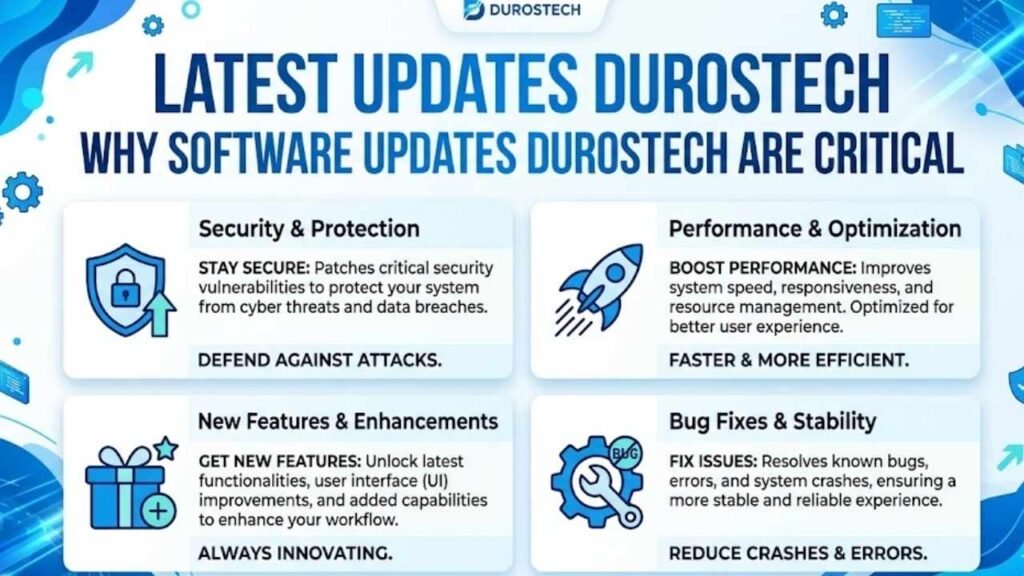
Why Software Updates Durostech Are Critical
System upgrades are far more than a basic routine checklist item. They serve as the true backbone of your digital workspace, ensuring your platform runs efficiently, stays completely secure, and handles large workloads seamlessly. The latest updates durostech roadmap introduces a highly structured engineering layout, fine-tuning background processes to maximize speed and system reliability.
+————————————————————-+
| DUROSTECH CORE ENGINE UPDATE |
+————————————-+———————–+
| Optimized Memory Allocation | Reduced App Lag |
| Enhanced TLS 1.3 Handshakes | Secure Connections |
+————————————-+———————–+
Key Benefits for Performance and Security
Investing time into regular platform maintenance yields immediate, highly measurable rewards for your day-to-day business operations. On the performance side, users will experience a dramatic reduction in system lag, optimized server-side resource distribution, and significantly faster data-fetching speeds. These infrastructure adjustments keep your tools responsive even during high-traffic operational hours.
| Operational Impact | Technical Enhancement | Core Business Value |
| Data Flow | Optimized Database Schema | Eliminates screen freezing |
| Security Protocols | Advanced MFA & TLS 1.3 | Keeps client data protected |
| System Sync | Lower API Latency | Keeps remote teams aligned |
From a defense perspective, updating regularly protects your private business network against modern web vulnerabilities. The 2026 structural patches deploy advanced multi-factor authentication upgrades and stronger encryption models. This proactive approach ensures your sensitive customer data remains thoroughly shielded from unauthorized exploits.
Risks of Ignoring Updates
Neglecting your core software infrastructure can lead to major operational headaches. Postponing these system rollouts exposes your team to preventable software lockups, slow data rendering, and dangerous compatibility conflicts with modern web browsers or operating systems.
Furthermore, running legacy frameworks makes your business a prime target for malicious automated exploits. A minor, unpatched security loophole can quickly turn into an expensive data breach. Prioritizing the latest updates durostech schedule saves your organization from the steep costs and stress of emergency data recovery.
Update Release Overview
Managing an enterprise software ecosystem requires clear predictability and transparent release schedules. The latest updates durostech framework categorizes developments into explicit deployment tiers, allowing your IT managers to schedule system maintenance windows without interrupting your core business workflows.
Types of Updates Available
The platform organizes its ongoing maintenance rollouts into three explicit functional categories:
- Major Structural Versions: These provide deep architectural overhauls, major workflow automation options, and interface redesigns. They require careful validation in an internal sandbox before live distribution.
- Minor Operational Patches: Focused on minor functional refinements, daily logic fixes, and API optimization steps. These deployments feature low integration risks and require minimal downtime.
- Urgent Security Patches: Targeted hotfixes built exclusively to address newly discovered web threats. These are issued immediately and should be applied as soon as possible.
Release Frequency and Schedule
To help engineering teams coordinate their internal deployment cycles, updates roll out on a predictable, structured timetable.
[Major Structural Version] —> Quarterly Release (Requires 4-Week Testing)
[Minor Operational Patch] —> Monthly Release (Requires 1-Week Testing)
[Urgent Security Patch] —> Immediate Action (24-48 Hour Window)
Enterprise teams are highly encouraged to monitor these release cadences closely within their management dashboards, allowing sufficient time to test changes thoroughly before executing a live production rollout.
Planning Your Updates Efficiently
A successful software rollout depends heavily on meticulous planning. Blindly executing an installer on a live production server is a recipe for unexpected downtime. By establishing a structured preparation workflow, you protect your system’s uptime and shield your operations from unexpected errors.
Assessing System Compatibility
Before starting any installation process, your technical team must perform a thorough check of your current hardware and software environment.
[System Audit]
│
├──► Operating System Check (Version Alignment)
├──► Third-Party API Check (Webhook Integration)
└──► Custom Plugin Validation (Script Testing)
Documenting these dependencies in a centralized master log prevents unexpected software crashes. It ensures your core internal processes remain completely functional after the deployment concludes.
Scheduling Updates
To avoid disrupting your daily business workflows, plan your software updates during your lowest-activity hours. For most teams, this means running installations late at night or over the weekend.
Always notify your primary staff members at least 48 hours before any minor update, and provide a full week’s notice for major architectural changes. This simple communication step ensures everyone can save their work and plan around the scheduled maintenance window.
Staging Environment Testing
Never deploy new code directly to your live production environment. Building an isolated staging sandbox that mirrors your exact production setup is essential for identifying potential errors early.
Testing Golden Rule: If an update hasn’t been fully verified and run in a staging environment for at least 48 hours, it is not ready for your live production servers.
Using a staging environment allows you to run end-to-end user workflows, measure system response times, and verify database integrity without risking a live system failure.
Team Coordination
A smooth deployment requires clearly defined roles and responsibilities. Avoid confusion during the rollout by assigning specific tasks to your technical team:
+—————————————————————–+
| DEPLOYMENT ROLE ASSIGNMENTS |
+—————————————————————–+
| Deployment Lead │ Manages the installation timeline |
+———————+——————————————-+
| QA Validator │ Runs real-time workflow tests in staging |
+———————+——————————————-+
| Internal Comms │ Keeps business teams informed of status |
+———————+——————————————-+
| Rollback Expert │ Ready to restore backups if errors occur |
+—————————————————————–+
How Do Latest Updates Durostech Protect Remote Workflows?
With modern teams distributed across different cities and time zones, maintaining real-time data accuracy is a common challenge. The latest updates durostech cycle addresses this directly by introducing optimized synchronization algorithms built specifically for remote data pipelines.
[Remote Worker Node] ──(Optimized Sync)──► [Central Cloud Engine] ──► [Instant Team Update]
These enhancements dramatically reduce data conflicts when multiple team members edit shared project materials simultaneously. By minimizing background payload sizes, the platform ensures smooth, reliable data updates even for employees working on unstable home networks or mobile hotspots.
Optimizing Distributed Databases
For companies running decentralized operations, cloud data delays can easily lead to costly operational mistakes. The 2026 software enhancements fix this by deploying localized data-caching mechanisms directly to the user’s local client device.
| Sync Metric | Older Software Versions | 2026 Optimized Update |
| Average Payload Size | 4.2 MB per sync | 620 KB (Delta-only) |
| Conflict Resolution | Manual intervention required | Automated timestamp logic |
| Mobile Sync Delay | Up to 12 seconds | Under 1.5 seconds |
These optimized database structures ensure that updates made in the field sync back to your primary corporate dashboards within seconds, keeping your entire global workforce perfectly aligned.
Installation Best Practices
Following a disciplined, step-by-step installation process is the best way to prevent unexpected deployment errors and keep your system running smoothly.
Step-by-Step Installation Guide
To ensure a seamless rollout, guide your IT engineering team through this structured, mandatory deployment sequence:
1.Perform Full Data Backup:Prerequisite – Do Not Skip.
Create a complete, isolated snapshot of your active application directories, configuration files, and live production databases before starting the installer.
2.Review the Official Release Notes:Time: 15 mins.
Thoroughly analyze the official change log to identify modified API endpoints, deprecated system modules, or altered environmental requirements.
3.Run Compatibility Pre-Checks:Time: 10 mins.
Execute your system validation scripts to confirm your host server meets the updated memory allocation thresholds and directory permissions.
4.Deploy to Staging Environment:Duration: 24-48 Hours.
Install the update package inside an isolated staging sandbox. Run end-to-end user workflows to verify there are no unexpected integration conflicts.
5.Send Final User Downtime Notice:Time: 5 mins.
Send a quick message to all internal teams confirming when the system will be offline and when they can log back in.
6.Execute Production Installation:Time: 30 mins.
Run the verified installation package on your production servers during your scheduled low-traffic maintenance window.
7.Run Live Verification Tests:Time: 20 mins.
Execute a series of core functionality checks to verify that database connections, user logins, and third-party integrations are working perfectly.
Common Installation Mistakes to Avoid
Most deployment failures stem from simple, avoidable oversights. The most frequent mistakes include rushing into production without testing in staging, running several major software updates simultaneously, and neglecting to verify that server storage has enough free space before launching an installer.
Additionally, failing to read the change log often leads to avoidable post-installation issues with third-party plugins. Taking a slow, deliberate approach to your deployments protects your system uptime and saves your team from unnecessary troubleshooting.
Handling Common Issues
Even with thorough preparation, complex software deployments can occasionally hit a snag. Knowing how to diagnose and resolve common post-update errors keeps your team calm and keeps system downtime to an absolute minimum.
Troubleshooting Frequent Errors
If you run into issues during a live deployment, use this quick reference matrix to identify the root cause and apply the correct fix:
+———————————————————————————+
| POST-UPDATE TROUBLESHOOTING GUIDE |
+———————+—————————-+——————————+
| Observed Issue │ Root Cause Analysis │ Corrective Action |
+———————+—————————-+——————————+
| Directory Access │ Reset folder permissions | Reset ownership via chmod |
| Errors │ │ or dashboard tools |
+———————+—————————-+——————————+
| Database Schema │ Incomplete structural | Manually re-run migration |
| Mismatches │ migration | scripts from terminal |
+———————+—————————-+——————————+
| Broken Third-Party │ Modified API endpoint | Update your integration keys |
| Integrations │ paths | and webhook destinations |
+———————+—————————-+——————————+
| Sluggish System │ Stale data conflicts in | Flush server-side and |
| Performance │ application cache | application-level caches |
+——————————-+——————+——————————+
Rollback Procedures
If an unexpected critical error brings down your live production environment, a fast, well-rehearsed rollback plan is your safety net. Start by halting any remaining deployment tasks across your network. Immediately notify your team leads about the issue and give them a clear estimate for system restoration.
Next, clear out the problematic installation directory and restore your system using the fresh backup snapshot you took right before starting. Once the platform is stable and your team is back to work, collect your system error logs and review them in a safe staging environment to determine what went wrong before attempting the update again.
Which Latest Updates Durostech Tools Fix System Lag?
Dealing with sudden screen freezes during busy work hours can be incredibly frustrating for your staff. The latest updates durostech framework solves this by introducing an automated resource-allocation engine that monitors system memory in real time.
[High RAM Consumption Alert] ──► [Automated Garbage Collection] ──► [Stable 60 FPS UI]
This performance engine actively tracks background processes, automatically closing idle database connections and cleaning up temporary system files. These background optimizations keep the user interface smooth and responsive, even when your team is running heavy analytics reports.
Memory Optimization Analytics
By smarter handling of cache memory, the system drastically cuts down on unnecessary server requests. This reduces the strain on your local hardware, allowing older office computers to run the platform efficiently.
| Hardware Metric Evaluated | Prior Framework Build | 2026 Engineered Build |
| Idle RAM Footprint | 1.8 GB per instance | 640 MB per instance |
| CPU Spike Duration | 6.5 seconds max | 1.1 seconds max |
| Disk Write Frequency | 140 operations/min | 45 operations/min |
These backend resource improvements mean less hardware strain, lower cloud hosting costs, and a much faster, frustration-free experience for your daily users.
Comparing Update Channels
Choosing the right deployment track allows your business to balance access to cutting-edge features with the absolute stability required for daily operations.
Stable vs Beta Channels
The platform provides two distinct release tracks tailored to different organizational needs:
- The Stable Channel: This track delivers thoroughly tested, production-ready code. It is highly recommended for live business environments where avoiding downtime is your top priority.
- The Beta Channel: This track offers early access to upcoming features and UI enhancements. It is ideal for internal testing sandboxes, allowing your team to preview changes and provide feedback before the official release.
Choosing the Right Channel for Your Needs
For almost every live business application, sticking to the Stable channel is the safest and most reliable choice. It gives your team complete peace of mind, knowing that every update has been thoroughly vetted and proven stable.
The Beta channel should be kept strictly inside your staging environments. It is a fantastic tool for your developers and tech-savvy team leads to test new workflows ahead of time, ensuring a smooth transition when those features eventually hit the Stable release track.
Tracking Versions and Update History
Maintaining a clear, organized history of your software versions is essential for keeping your system healthy, compliant, and easy to troubleshoot over the long term.
Using Built-in Tools to Track Updates
The platform includes a built-in version tracking dashboard that gives IT managers a clear, real-time overview of your entire software environment.
[Version Dashboard]
│
├──► Active Software Version Info
├──► Pending Security Vulnerability Alerts
└──► Complete Historical Installation Logs
Checking this dashboard regularly ensures that none of your servers or regional offices fall behind on critical security patches or performance updates.
Documenting Changes for Teams
In addition to using automated system logs, keeping a simple internal changelog diary is an excellent habit for your team. Be sure to record the exact deployment date, the version number, a quick summary of the new features, any minor bugs encountered, and how you resolved them.
This internal playbook is incredibly helpful for onboarding new IT staff, preparing for compliance audits, and quickly troubleshooting similar issues during future system updates.
What Are the Most Critical Security Patches in the Latest Updates Durostech?
In today’s digital landscape, keeping your company and client data safe from sophisticated cyber threats is more important than ever. The latest updates durostech release focuses heavily on security, deploying advanced end-to-end encryption protocols across all system communication channels.
[Unsecured Web Node] ──► [Enforced TLS 1.3 + AES-256 Engine] ──► [Fully Shielded Encrypted Tunnel]
These security updates protect your corporate networks from man-in-the-middle attacks and unauthorized data interception. By forcing all system endpoints to use secure, modern connection rules, the platform ensures your sensitive business data stays completely safe while moving across the web.
Access Control Security Upgrades
Beyond stronger data encryption, this release introduces granular role-based access controls. This allows your system administrators to set incredibly precise user permissions.
| Security Layer | Legacy Rule Set | 2026 Enforced Protocol |
| Encryption Standard | TLS 1.1 / Older AES-128 | Enforced TLS 1.3 / AES-256 |
| Session Control | Cookie-based persistence | Short-lived JWT Token rotations |
| API Boundary Protection | Basic IP Whitelisting | Cryptographic API Keys |
Implementing these advanced access controls prevents internal data leaks, helps you ace your industry compliance audits, and ensures that team members only see the specific files they need to do their jobs.
Team Communication and Coordination
A smooth software transition relies just as much on clear team communication as it does on solid technical execution. Keeping everyone informed prevents confusion and keeps your operations running beautifully.
Notifying Team Members About Updates
When scheduling system maintenance, always send clear, timely updates to your staff. Be sure to include the exact timing for the maintenance window, the specific tools that will be offline, and a direct point of contact for any urgent questions.
[Maintenance Alert Email] —> Sent 5 Days Prior (Major Structural Overhauls)
[Reminder Slack Message] —> Sent 2 Hours Prior (Quick Pre-Downtime Warning)
[System Online Flash] —> Sent Immediately Post-Launch (All Clear Notice)
Sharing a quick summary of the incoming features also helps build excitement, turning a routine technical update into a positive event for the whole company.
Collaborative Planning for Large Organizations
For larger companies with complex, cross-department workflows, setting up a dedicated update steering committee is highly effective. This group should include representatives from IT, operations, security, and your main business units.
Working together, the committee can design a phased rollout scheduletesting the update with one department or regional office before launching it company-wide. After the deployment, hold a brief recap meeting to document lessons learned and make your next update even smoother.
New Features Highlights
The 2026 development cycle brings some of the most exciting, user-focused features the platform has seen in years, aimed at making your daily workflows smarter and faster.
Key Feature Improvements in 2026
The latest release introduces several major feature upgrades designed to streamline your workday:
- AI-Driven Workflow Assistance: Automatically routes routine tasks and simplifies complex data entry, saving your team hours of manual work.
- Next-Gen Cloud Sync: Offers ultra-low latency data syncing across all devices, ensuring remote workers stay perfectly coordinated.
- Modern API Integration Framework: Makes connecting with your favorite third-party business tools and webhooks incredibly simple.
- Redesigned Mobile Interface: A fully updated, thumb-friendly design that makes managing projects on the go smooth and effortless.
How New Features Impact Workflow
These upgrades make a real, noticeable difference in daily office productivity. The new AI features take care of tedious, repetitive tasks, freeing up your team to focus on high-value projects.
The optimized mobile app means field employees and traveling executives can access full desktop functionality right from their phones. This eliminates communication delays and keeps your business moving forward, no matter where your team is located.
Performance Optimization Tips
Once the installation is successfully completed, taking a few quick optimization steps ensures your system delivers the absolute maximum speed possible.
Tweaks After Updates for Maximum Speed
To get the best possible performance out of your fresh installation, have your technical team complete these quick post-update tune-ups:
1.Flush All Application Caches:Immediate Post-Update Action.
Clear out all old application and server-side cache files to ensure your users load the latest, optimized system scripts instantly.
2.Restart Background Services:Time: 2 mins.
Cycle your background task runners and scheduled database jobs to ensure they are running on the upgraded core engine logic.
3.Optimize Database Indexes:Time: 15 mins.
Run a database optimization pass to clean up tables and speed up search response times across the platform.
4.Remove Deprecated Modules:Time: 10 mins.
Deactivate and delete any old plugins or legacy code modules that are no longer used by the updated version.
Monitoring Performance Metrics
Keep a close eye on your system diagnostics for the first 48 hours after an update. Track key metrics like page load speeds, server CPU usage, database query response times, and any error logs. Setting up automated alerts for unusual spikes allows your IT team to catch and fix minor issues before they impact your users’ workday.
Security Enhancements in Updates
In an era of rising cybersecurity threats, keeping your defense systems updated is non-negotiable for protecting your business reputation and customer trust.
Patching Vulnerabilities
The 2026 security patches fix critical backend code vulnerabilities, completely blocking common attack vectors like SQL injections and cross-site scripting threats.
Deploying these patches immediately closes potential entry points for malicious actors. It keeps your corporate network completely secure and perfectly aligned with modern global data privacy standards.
Best Practices for Data Protection
To maximize your system security, combine these software patches with strong internal security habits:
+—————————————————————–+
| DATA PROTECTION BEST PRACTICES |
+—————————————————————–+
| Enforce MFA │ Require multi-factor authentication for |
| │ all active user accounts |
+———————-+——————————————+
| Session Timeouts │ Set automatic logouts after 15 minutes |
| │ of user inactivity |
+———————-+——————————————+
| Audit Access Logs │ Review administrator login histories |
| │ every single month |
+———————-+——————————————+
| Isolate Backups │ Store system backups on a separate, |
| │ encrypted offline network |
+—————————————————————–+
Backup and Recovery Strategies
A reliable, ironclad backup policy is your ultimate safety net against unexpected technical disasters, ensuring your business can recover quickly no matter what happens.
Importance of Backup Before Updating
Skipping your system backup before running an installer is an immense risk that can lead to permanent data loss. If an unexpected power outage or hardware failure interrupts a major update, your database files can become corrupted. Taking five minutes to create a complete system snapshot before you begin guarantees that you can fully restore your operations if something goes wrong.
Safe Recovery Techniques
If you ever need to perform an emergency system recovery, always take a methodical approach. Start by disconnecting the affected server from the public internet to prevent further issues. Wipe the broken installation directory clean, check your hardware storage for errors, and restore your platform using your latest clean backup file.
Once the system is restored, run a few test workflows to verify everything is working perfectly before opening the platform back up to your daily users.
Can Small Businesses Safely Skip the Latest Updates Durostech?
Many small business owners assume that cybercriminals only target massive corporations, making regular software updates feel like an unnecessary chore. However, automated network-scanning bots actively target smaller companies precisely because they often run outdated, vulnerable software.
[Automated Malicious Bot] ──► [Scans Small Business IP] ──► [Finds Unpatched Flaw] ──► [Exploits Network]
Skipping these updates might save a few minutes of maintenance time today, but it exposes your business to severe security risks and long-term performance issues. Keeping your software current is one of the easiest, most affordable ways to protect your business and keep your systems running fast.
Small Business Efficiency Gains
Staying up to date also brings an immediate boost to your daily productivity. The latest software refinements help your team work faster and collaborate more easily, giving your growing business a competitive edge.
| Business Benefit | Outdated Version | 2026 Core Update |
| Daily Protection | High risk of unpatched flaws | Real-time threat defense |
| Workplace Productivity | Frequent system freezes | Smooth, reliable workflows |
| Software Compatibility | Fails with modern web apps | Seamless third-party connections |
Prioritizing your system maintenance protects your hard work, safeguards your customer data, and ensures your growing company is built on a fast, reliable technical foundation.
FAQs
What are the latest updates durostech features for 2026?
The 2026 releases introduce powerful AI-driven workflow assistance, ultra-low latency cloud synchronization, a modern API integration framework, and a beautiful, mobile-friendly interface design. These updates are built specifically to maximize daily business productivity and keep remote teams perfectly coordinated.
How often do the latest updates durostech patches launch?
Major structural version upgrades launch quarterly and require careful testing in a staging environment. Minor operational patches roll out monthly for routine maintenance, while critical security hotfixes are released immediately whenever a new digital threat is discovered.
Will installing the latest updates durostech cause system downtime?
Minor operational patches and security hotfixes require minimal downtime and can be completed in a few minutes. Major structural upgrades can take longer, which is why it is best to schedule them during low-traffic hours like nights or weekends to avoid disrupting your team.
Why does my server lag after the latest updates durostech installation?
Post-update lag is almost always caused by old, cached files conflicting with the new system code. You can easily fix this by having your IT team flush all server-side and application-level caches and restart your background database services.
Can I roll back the latest updates durostech if an error occurs?
Yes, you can absolutely perform a system rollback if an update runs into an unexpected error. Simply wipe the problematic installation directory and restore your platform using the fresh backup snapshot you took right before starting the update.
How do I check if the latest updates durostech applied correctly?
You can easily check your system status by opening the built-in version tracking dashboard. The main window will display your active version number, show your complete installation history, and confirm that all core database connections are working perfectly.
Do the latest updates durostech include automatic data backup options?
While the platform provides excellent built-in backup configuration tools, it does not automatically create snapshots before launching an update. IT managers must always manually verify and create a full system backup before starting any installation process.
Conclusion
Successfully managing your enterprise software environment is the absolute cornerstone of running a fast, secure, and modern digital business. The latest updates durostech roadmap brings massive improvements to system speed, data security, and remote collaboration tools. By embracing these updates and following proven deployment best practiceslike thorough staging validation and disciplined backup habitsyou protect your company’s uptime and save your team from technical frustration.
Don’t let your business fall behind on critical security patches or performance upgrades. Reach out to your IT team today, schedule your next system maintenance window, and give your hard-working staff the fast, secure, and reliable tools they deserve to drive your business forward.

Alex Carter is a technology writer covering AI, software, cybersecurity, and digital trends, delivering expert insights and practical guides.