
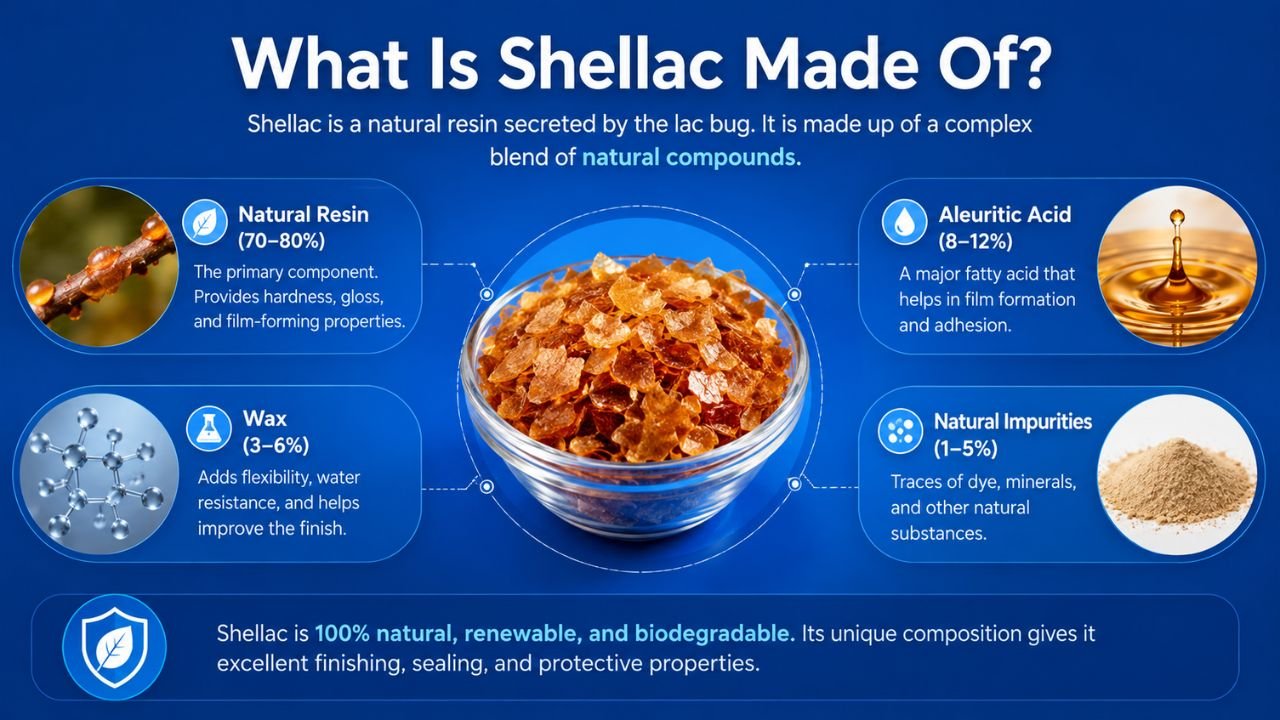
When you bite into a shiny, crisp apple or admire the deep, mirror-like gloss on a vintage mahogany dining table, you rarely think about insects. Yet, a hidden connection exists between your everyday items and a tiny creature thousands of miles away. If you have ever paused to wonder what is shellac made of, the true answer is far more fascinating and natural than any factory-made synthetic chemical.
This multi-purpose material forms an invisible boundary in our lives, protecting everything from our wooden floors to the pills we swallow when we are sick. Understanding the origin of this remarkable glaze shifts how we look at daily consumer products. Let us pull back the curtain on the shellac bug and trace the journey of this organic wonder from wild tree branches right into our homes.
What is shellac made of
For centuries, makers and builders have relied on this unique glaze without fully realizing its complex biological origin. When asking what is shellac made of, the literal answer is a complex mixture of hydroxy fatty acids and poly-esters. It is an all-natural polymer secreted by tiny insects to protect their offspring from harsh tropical weather and hungry forest predators.
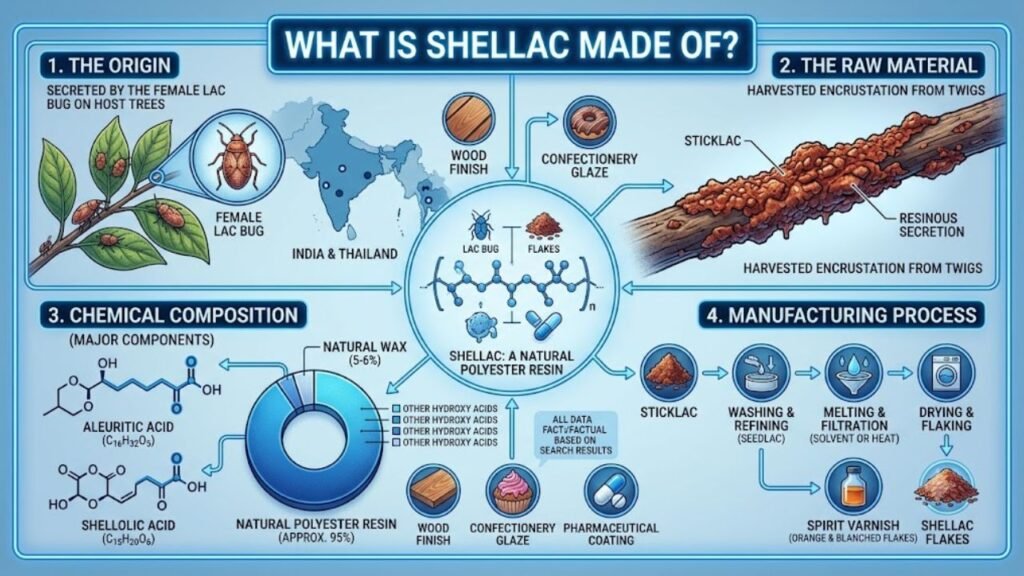
Humans harvest this raw, crusty material and process it into dry, translucent flakes that dissolve easily in denatured alcohol. Once dissolved, it becomes a liquid finish that dries rapidly into a hard, protective barrier. Because it is completely non-toxic when dry, it serves functions that modern synthetic plastics simply cannot mimic safely or sustainably.
Crucial Insight: Unlike polyurethane or lacquer, which are derived from petroleum chemicals, pure shellac is entirely organic, renewable, and biodegradable.
| Industrial Grade | Primary Processing Color | Common Consumer Use |
| Seedlac | Deep Amber / Reddish Brown | Base coats, heavy wood sealing |
| Button Lac | Warm Golden Brown | Musical instruments, antiques |
| Dewaxed Flakes | Pale Straw to Clear | Food glazes, cosmetic finishes, topcoats |
Shellac bug
The incredible creature behind this global industry is the Kerria lacca, commonly known as the shellac bug. These microscopic insects belong to the scale family and thrive by the millions in the warm, humid forests of South Asia. They survive by piercing the tender bark of specific host trees to suck out the sap, absorbing nutrients to sustain their massive colonies.
As these insects feed, they excrete a thick, amber-colored resin that rapidly hardens upon contact with the open air. This resin spreads across the tree branches, fusing together into a dense, protective tube that shields the vulnerable shellac bug from scorching sun and heavy monsoons. This natural survival mechanism provides the raw material that fuels a massive global manufacturing network.
What is shellac made from
Tracing the supply chain reveals that this material is built entirely on a foundation of insect secretions and forest ecology. When exploring what is shellac made from, we look at a combination of natural resin, wax, and small amounts of organic coloring matter. The raw material, known as sticklac, contains about 70% to 80% pure resinous matter along with natural insect waxes that give the substance its flexibility.
During factory processing, workers wash the raw crust repeatedly to remove water-soluble red pigments, dirt, and plant fibers. Manufacturers can leave the natural waxes intact for traditional woodworking or filter them out to create dewaxed varieties. This flexibility allows the final material to adapt to delicate applications like pill coatings or heavy-duty wood primers.
Is shellac made from bugs
A common point of confusion for consumers is whether the final product contains the actual bodies of the insects themselves. To be entirely precise, the glaze is made by bugs, not of bugs, meaning it is an excreted product rather than a ground-up insect. The tiny creatures build their protective cocoons on the outside of their bodies, leaving their physical structures separate from the resin.
However, because millions of tiny organisms crowd closely together on a single branch, some insect fragments naturally get trapped in the sticky crust. Thorough industrial filtration and refining processes remove these fragments completely before the flakes reach the market. When you use the final refined product, you are utilizing a purified biological fluid, not compressed insect bodies.
What is shellac in food
If you look closely at the ingredient labels on your favorite sweet treats, you will often find a component listed as “confectioner’s glaze” or “resinous glaze.” This ingredient explains exactly what is shellac in food applications, where it provides a high-gloss sheen and locks in moisture. It keeps candies from melting in your hands and prevents fresh fruits from drying out and spoiling on grocery store shelves.
This completely natural coating acts as an effective, gas-permeable moisture barrier that extends the shelf life of perishable items. It preserves the natural crispness of jelly beans, chocolate gems, and citrus fruits during long shipping journeys. Because it is completely indigestible by the human gastrointestinal tract, it passes through the body safely without being absorbed into the bloodstream.
What is shellac nails
The beauty industry has adapted this ancient natural resin to revolutionize modern manicures and hand care. In the salon world, a shellac manicure blends traditional nail polish with a specialized gel polymer to create a highly durable coating. This formula cures under an ultraviolet or LED lamp, creating a tough, glossy finish that resists chipping for up to two full weeks.
It is important to note that modern nail formulations are distinct from the pure wood varnish found in hardware stores. The beauty product combines the natural insect-derived resin with synthetic acrylates to ensure the coating remains flexible on the human nail plate. This hybrid blend delivers long-lasting wear while allowing for safe removal using standard acetone wraps without damaging the underlying tissue.
What Is the Difference Between Shellac and Polyurethane?
Many homeowners wonder how this traditional insect secretion compares to modern synthetic floor and furniture finishes. While synthetic polyurethane creates a thick, plastic-like shield over wood surfaces, it relies on heavy chemical solvents that emit strong fumes during application. It forms a non-porous layer that can scratch easily and proves difficult to repair without sanding down the entire surface.
In contrast, an insect-derived finish dissolves naturally in alcohol and bonds beautifully to old coats without requiring extensive sanding. It highlights the deep, natural grain of fine hardwoods without leaving a plastic look or yellowing aggressively over time. While it is less resistant to pooling water and alcohol spills than polyurethane, its ease of localized repair makes it a favorite among antique restorers.
What is shellac made from in india
India serves as the historical heartland for the cultivation and export of this traditional material, producing the vast majority of the global supply. Understanding what is shellac made from in india requires looking at specific host trees like the Palas, Kusumi, and Ber trees. These native trees provide the nutrient-rich sap that local insect populations need to produce high-quality resin.
Rural farmers, known as lac cultivators, carefully manage these forest tracts, transferring insect colonies to fresh branches to sustain production. The seasonal harvest provides vital income for indigenous communities in states like Jharkhand, Chhattisgarh, and West Bengal. This traditional agricultural practice keeps ancient forest ecosystems protected from deforestation while supporting sustainable local economies.
Is shellac halal Is shellac vegetarian
Dietary restrictions raise valid concerns about consuming items coated in insect secretions, leading many to ask is shellac halal or suitable for a vegetarian lifestyle. Islamic scholars generally classify the ingredient as halal because the resin is an excretion rather than a fluid obtained by slaughtering an animal. Major halal certification bodies permit its use in foods and pharmaceuticals as long as it is processed without prohibited alcohol solvents.
For vegetarians and vegans, the answer depends entirely on personal ethical boundaries. Because it is an animal-derived byproduct that requires harvesting from nature, it is not considered strictly vegan. Traditional vegetarians who consume honey and use beeswax often accept it, while strict vegans avoid it due to the potential harm or displacement caused to the insect colonies during collection.
How is shellac harvested
The collection process requires immense patience, manual labor, and a deep understanding of seasonal insect lifecycles. To understand how is shellac harvested, one must picture workers climbing high into tree canopies to prune encrusted branches, known legally as sticklac. This harvesting happens twice a year, timed carefully right after the young insects hatch and leave the old communal crust behind.
Once gathered, workers scrape the hardened resinous crust away from the wooden twigs using specialized hand tools. The scraped material is crushed, sifted to remove large debris, and washed thoroughly in water vats to remove natural red dye. The semi-refined grains, called seedlac, are dried under the sun before being melted down or chemically dissolved into industrial flakes.
Is shellac safe to eat
Regulatory agencies around the world, including the United States Food and Drug Administration, classify this substance as Generally Recognized as Safe (GRAS). When wondering is shellac safe to eat, decades of toxicological data confirm that it poses zero health risks to human consumers. It contains no heavy metals or toxic chemical additives when processed under strict food-grade manufacturing guidelines.
Because our digestive enzymes cannot break down the complex polymer chains of the resin, it passes completely unchanged through the human body. It serves a vital medical purpose by coating time-release capsules, ensuring life-saving medicines survive stomach acid to dissolve safely in the intestines. This biological neutrality makes it an incredibly reliable tool for both confectioners and pharmaceutical engineers.
Why Do Manufacturers Use Shellac on Fresh Produce?
When walking through the grocery store produce aisle, you might notice that oranges, lemons, and apples look remarkably bright and glossy. Farmers apply a micro-thin layer of food-grade glaze to replace the natural protective waxes washed away during post-harvest cleaning. This thin coating slows down the respiration rate of the fruit, preventing it from losing moisture and shriveling during transport.
Without this protective barrier, fresh citrus and pomme fruits would lose their crisp texture and spoil within days of arrival. The coating seals in natural moisture while preventing external mold spores and bacteria from penetrating the skin. This sustainable practice reduces food waste across global supply chains, keeping nutritious produce affordable and accessible throughout the year.
Can You Make a DIY Shellac Finish at Home?
One of the greatest benefits of this historic material is how easily it can be prepared by woodworkers and hobbyists at home. By purchasing dry flakes from a specialty supplier, you can mix your own fresh batch using standard denatured alcohol. This DIY approach ensures you avoid the shelf-life issues common with pre-mixed commercial cans, which can degrade over time.
To mix your own finish, you simply choose a specific “pound cut,” which refers to the weight of flakes dissolved in one gallon of alcohol. A standard two-pound cut provides an excellent all-around consistency for sealing raw wood, applying smoothly with either a brush or a cotton pad. Mixing your own finish allows you to control the thickness, color depth, and purity of your final project coating.
What Are the Environmental Benefits of Using Shellac?
In an era dominated by synthetic plastics and petroleum-derived chemical coatings, this insect secretion stands out as an eco-friendly alternative. Because it is harvested from living trees without damaging the forest canopy, its production encourages the preservation of natural woodland habitats. It requires significantly less industrial energy to refine compared to modern synthetic chemical sealers.
When a coated object reaches the end of its lifecycle, the finish breaks down naturally in the environment without releasing toxic microplastics. It does not off-gas harmful volatile organic compounds (VOCs) into your living space, making your indoor air quality much safer during application. Choosing this renewable material supports traditional forest communities while reducing our reliance on fossil fuels.
FAQs
What is shellac made of exactly?
It is made from the purified resinous secretions of the tiny Kerria lacca insect. These insects leave the crust on tree branches, which humans harvest and refine into dry flakes.
Is the shellac bug harmed during the harvesting process?
Most harvesting is timed carefully to occur after the new generation of insects has emerged from the crust. This minimizes harm to the living colony while clearing the old resin for human use.
What is shellac made of when used in food products?
In food, it consists of highly purified, dewaxed flakes dissolved in food-grade alcohol. It creates a shiny, protective barrier known as confectioner’s glaze on candies and fresh fruit.
Is shellac made of any toxic chemical compounds?
No, it is a completely natural, organic polymer that contains no synthetic toxins. It is entirely safe for human consumption and interior home use when properly refined.
What is shellac made of to make it stick to wood?
The natural secretion contains unique hydroxy fatty acids that allow it to form a powerful mechanical bond with wood fibers. It dries quickly as the alcohol solvent evaporates into the air.
Is shellac made of materials that are considered vegan?
Because it is an animal product secreted by insects, it is not considered vegan by global standards. However, many traditional vegetarians still consume it safely.
What is shellac made of when applied to salon nails?
Nail formulas combine the natural insect-derived resin with cosmetic-grade synthetic gel polymers. This hybrid blend allows the polish to cure quickly under an ultraviolet lamp for long-lasting wear.
Conclusion
Unraveling the mystery of what is shellac made of highlights the incredible engineering power found within the natural world. From the industrious shellac bug protecting its young on a distant tree branch to the gleaming finish on a prized family heirloom, this organic resin remains a true marvel. It bridges the gap between ancient forestry practices and modern industrial needs, proving that nature often provides the best solutions.
While synthetic alternatives continue to dominate consumer shelves, this renewable resource holds an irreplaceable position in food, medicine, and fine woodworking. By understanding what is shellac made of, we can make more informed, sustainable choices for our health and our homes. The next time you appreciate a polished surface or a bright piece of candy, take a moment to appreciate the tiny shellac bug that made it all possible.

Alex Carter is a technology writer covering AI, software, cybersecurity, and digital trends, delivering expert insights and practical guides.