
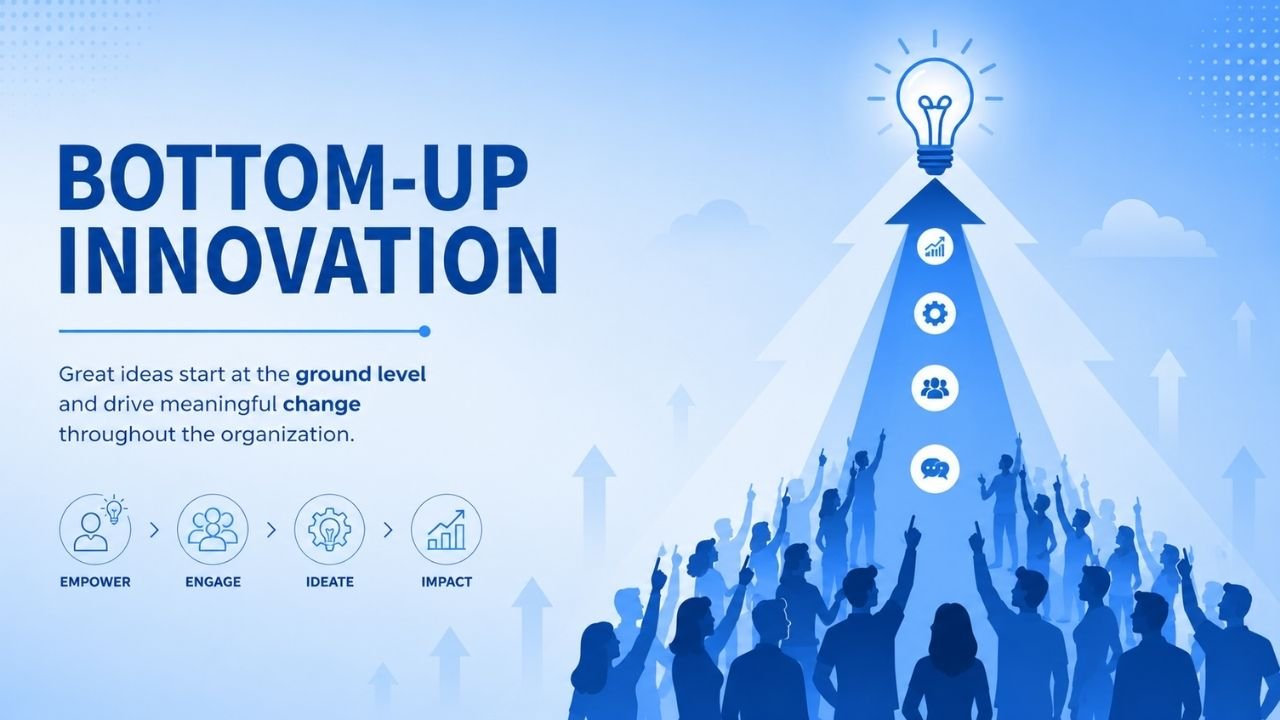
Most companies wait for their leadership to hand down the next big idea. But some of the best breakthroughs in enterprise history came from someone much closer to the work a developer, a support agent, a warehouse manager. AI bottom-up innovation is the mindset that finally gives those people the tools to act on what they already know. It changes not just what organizations build, but who gets to build it.
This article covers everything you need to understand about AI bottom-up innovation from what it is and why it matters, to real-world examples, the challenges companies face, and where this movement is headed. If you want your organization to stop waiting for the future and start building it, you are in exactly the right place.
What Is AI Bottom-Up Innovation?
AI bottom-up innovation describes a model where artificial intelligence tools empower employees at every level not just executives or data scientists to generate ideas, test solutions, and improve processes. Instead of waiting for leadership to define what needs to change, frontline workers use machine learning, natural language processing (NLP), and predictive analytics to identify problems and act on them directly. This is grassroots innovation at an organizational scale, made faster and smarter by AI.
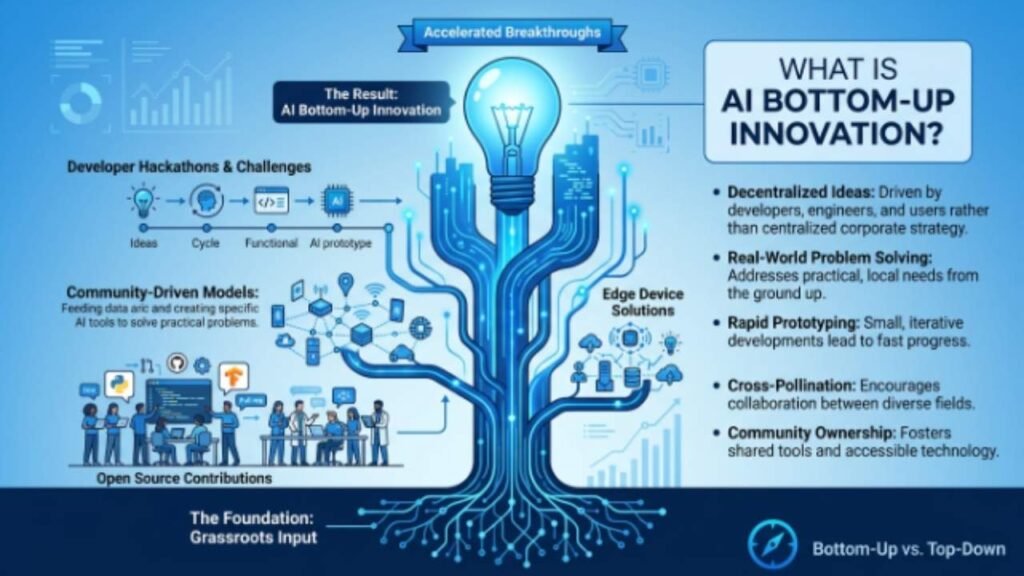
Traditional enterprise innovation typically flows from the top down. A leadership team sets a strategic direction, a project gets funded, and teams execute it over months or years. Bottom-up AI reverses that flow. An employee spots an inefficiency in a daily workflow, uses an AI tool to analyze patterns, and proposes a data-backed solution all within days. The result is a more adaptive, more responsive organization where insights from the ground level actually reach and shape the business.
| Traditional Top-Down Model | AI Bottom-Up Innovation Model |
| Executive-driven strategy | Employee-driven experimentation |
| Slow approval cycles | Fast iteration with AI tools |
| Limited contributor pool | Organization-wide participation |
| Gut-feel decisions | Data-driven proposals |
| Annual innovation cycles | Continuous improvement loops |
Why Enterprises Are Adopting Bottom-Up Innovation
There is a reason enterprise leaders are paying close attention to bottom-up models right now. The competitive pace of digital transformation means companies can no longer afford to let good ideas die in suggestion boxes. AI bottom-up innovation gives organizations a structural advantage: the people who understand operations most deeply are now equipped to improve them. When AI handles the heavy lifting of data analysis, employees can focus on creative problem solving and strategic thinking.
The shift also addresses a growing frustration inside large organizations. Talented employees often feel their ideas are ignored or buried in processes designed for stability rather than change. When companies deploy AI-powered collaboration platforms, employee engagement rises because people see their contributions matter. This is not just a cultural benefit it directly impacts retention, productivity, and the quality of innovation output.
- Employees closest to the work detect inefficiencies that leadership cannot see.
- AI tools lower the technical barrier to proposing and testing new ideas.
- Faster feedback loops keep innovation relevant to real business needs.
- Data-backed proposals are easier to approve and fund at the executive level.
- Bottom-up models build organizational resilience by spreading innovation capacity.
How AI Supports Bottom-Up Innovation
AI does not replace human creativity in a bottom-up model it amplifies it. The right tools transform a good instinct into a data-supported proposal that can move quickly through an organization. Data analysis and insights platforms allow employees to query large datasets without a dedicated analytics team. Automation of routine tasks frees up time that was previously locked in repetitive work, giving employees the bandwidth to think differently about their roles.
Predictive analytics is particularly powerful in this context. When machine learning models can forecast the likely outcome of a proposed process change, employees are no longer asking leadership to take a leap of faith. They arrive with evidence. AI-powered collaboration tools add another layer by helping teams share findings across departments, so a breakthrough in logistics can inform a similar problem in procurement almost instantly.
| AI Capability | How It Enables Bottom-Up Innovation |
| Natural Language Processing (NLP) | Employees query data in plain language without coding skills |
| Machine Learning Models | Forecast outcomes of proposed changes before implementation |
| Automated Workflow Tools | Free up employee time for creative and strategic thinking |
| Collaboration AI Platforms | Spread insights and ideas across departments efficiently |
| Computer Vision | Operational staff identify physical process inefficiencies |
What Is the Difference Between Bottom-Up and Top-Down AI Innovation?
This is one of the most common questions about AI bottom-up innovation, and it matters because the answer determines which model suits your organization. Top-down AI innovation is centralized. Leadership defines the use cases, a dedicated AI team builds the solutions, and the business deploys them at scale. It works well for large, high-stakes transformations like enterprise-wide ERP integrations or major infrastructure upgrades. But it is slow, expensive, and disconnected from the day-to-day realities of the people doing the work.
Bottom-up AI innovation is distributed. It starts at the operational level, where employees interact with tools, customers, and processes daily. They are the first to notice when something is inefficient, redundant, or broken. When organizations equip these employees with accessible AI tools, they can test ideas, gather data, and build lightweight solutions themselves. The best of these ideas then get resourced and scaled. The result is an innovation pipeline that is both faster and more aligned with real business pain points than anything a top-down mandate can produce.
| Dimension | Top-Down AI Innovation | Bottom-Up AI Innovation |
| Who drives it | Executives and AI teams | Frontline employees |
| Speed to prototype | Months | Days to weeks |
| Risk profile | High investment, high stakes | Low-cost experimentation |
| Alignment with real problems | Moderate | High |
| Scalability | Strong once deployed | Requires governance to scale |
Real-World Examples
The most compelling proof of AI bottom-up innovation is that the companies doing it best are already household names. Google has long operated with a philosophy that employees closest to a problem should have the freedom to experiment. Its famous “20% time” policy gave engineers permission to pursue side projects using internal AI tools a practice that produced some of its most successful products. The key was not the time itself, but the access to tools and data that made experimentation meaningful.
Microsoft has embedded AI analytics into its internal workflows so that teams across product, operations, and support can propose and test improvements independently. Amazon takes a similar approach on the warehouse floor, where operational employees use AI-powered dashboards to spot bottlenecks and propose logistics improvements in near real-time. These are not isolated experiments they are systematic efforts to make innovation a company-wide habit rather than a department-specific function.
- Google’s “20% time” produced Gmail, Google Maps features, and AdSense.
- Microsoft employees use internal AI tools to propose product and process improvements.
- Amazon’s operational staff drive logistics optimization from the floor level.
- Procter & Gamble uses AI platforms for cross-functional ideation at scale.
- Siemens deploys AI on the factory floor for employee-led process automation.
Benefits of Bottom-Up AI Innovation for Enterprises
The case for AI bottom-up innovation goes well beyond employee satisfaction. Organizations that build this capability gain a structural advantage that is hard to replicate. Increased agility is perhaps the most immediate benefit when ideas can move from observation to tested prototype in days rather than months, companies respond to market changes before competitors even recognize the problem. This speed is not about cutting corners; it is about putting the right tools in the hands of the right people.
Cost efficiency follows naturally. Bottom-up innovation uses lightweight AI tools and targeted experimentation, which means organizations invest only in ideas that show real promise before committing significant resources. Over time, a culture of innovation takes hold, where employees at every level see themselves as contributors to the company’s direction. This is a meaningful competitive advantage not because it sounds good in a values statement, but because it compounds. Organizations that innovate continuously from within get better at it every year.
| Benefit | Business Impact |
| Increased agility | Faster response to market and operational changes |
| Cost efficiency | Lower wasted investment on unproven initiatives |
| Culture of innovation | Higher employee engagement and retention |
| Competitive advantage | Speed-to-market advantage over slower competitors |
| Diverse problem-solving | Broader perspective leads to stronger solutions |
How Can Small and Mid-Sized Businesses Use AI Bottom-Up Innovation?
AI bottom-up innovation is not reserved for Fortune 500 companies with dedicated AI teams and nine-figure technology budgets. Small and mid-sized businesses are actually positioned to move faster with this model because they carry less organizational weight. A 50-person company where every employee has access to an AI productivity tool can iterate on its workflows in ways a 50,000-person enterprise cannot easily replicate.
The practical starting point for smaller businesses is tool access. Platforms like Microsoft Copilot, Notion AI, and various low-code automation tools now put machine learning capabilities in the hands of employees with no technical background. A customer service rep can analyze patterns in support tickets. A sales coordinator can model pipeline trends. A marketing specialist can test messaging hypotheses. None of these require a data science degree. They require curiosity, access, and an organizational culture that rewards experimentation rather than punishing failure.
Challenges and How to Overcome Them
No model this powerful comes without friction. AI bottom-up innovation faces real obstacles inside enterprise environments, and ignoring them is a fast path to failed adoption. Data privacy is the most critical concern. When employees across multiple departments start generating and acting on data-driven insights, organizations need clear governance frameworks to ensure that sensitive information is handled appropriately and in compliance with regulations like GDPR and CCPA.
Change management is equally important. Employees who have spent years in a top-down environment may be skeptical of a new model that asks them to experiment, potentially fail, and iterate. Leadership needs to communicate clearly why this model benefits everyone not just the organization. Integration with existing enterprise software is the third major hurdle. If AI tools create siloed data environments rather than connecting to the systems employees already use, adoption will stall. Organizations that overcome these challenges consistently share three characteristics: clear innovation guidelines, continuous learning programs, and cross-functional teams that blend technical skill with domain expertise.
- Establish data governance policies before deploying AI tools broadly.
- Run structured change management programs that address employee concerns directly.
- Choose AI tools with strong integration capabilities for existing enterprise stacks.
- Create cross-functional innovation teams that mix technical and operational talent.
- Build a psychological safety culture where experimentation and failure are both acceptable.
What AI Tools Are Best for Enabling Bottom-Up Innovation?
The technology layer is what makes AI bottom-up innovation practical rather than aspirational. The right tool removes the friction between an employee’s observation and their ability to act on it. Low-code and no-code AI platforms are foundational here they let employees build simple automation and analysis workflows without writing a single line of code. Tools like Power Automate, Zapier, and Airtable with AI integrations are already in use across thousands of mid-market organizations for exactly this purpose.
Generative AI tools like large language models have added a new dimension to the bottom-up model. Employees now use AI to draft proposals, summarize datasets, generate test cases, and write documentation all tasks that previously required specialized skills or significant time investment. Predictive analytics platforms like Google Looker, Tableau with Einstein AI, and AWS QuickSight bring data visualization and forecasting to non-technical users. The common thread across these tools is accessibility: they are designed to be used by the people closest to the problem, not just the people who understand the technology.
| Tool Category | Examples | Primary Use Case |
| Low-Code Automation | Power Automate, Zapier | Automate repetitive workflows without coding |
| Generative AI Assistants | Microsoft Copilot, ChatGPT | Draft, summarize, and analyze at speed |
| Predictive Analytics | Google Looker, Tableau AI | Forecast trends and model outcomes |
| Collaboration AI | Slack AI, Notion AI | Share insights and ideas across teams |
| AI-Powered Dashboards | AWS QuickSight, Sisense | Real-time operational data for frontline staff |
Is AI Bottom-Up Innovation Replacing Traditional Innovation Strategy?
This question surfaces often in executive conversations about AI bottom-up innovation, and the honest answer is: no, but it is fundamentally changing what traditional innovation strategy needs to do. Top-down strategy remains essential for setting organizational direction, allocating major resources, and managing enterprise-wide risk. What bottom-up AI does is change where the raw material for that strategy comes from.
When leadership makes strategic decisions based on data that flows up from employees interacting with real systems and real customers, those decisions get sharper. The data-driven decision-making ecosystem that bottom-up AI creates does not replace executive judgment it informs it with a quality and volume of insight that was previously unavailable. The most effective organizations are learning to do both: maintain a clear strategic framework from the top while building the structural capacity for continuous, distributed innovation from the bottom.
How to Build a Bottom-Up AI Innovation Culture Inside Your Organization
Building the culture is harder than deploying the tools, and it is also more important. AI bottom-up innovation does not take root in organizations that talk about empowerment but punish failure. The first cultural requirement is psychological safety employees need to know that testing an idea that does not work is a contribution, not a mistake. Leadership models this by sharing its own experiments openly, including the ones that failed.
The second requirement is visible recognition. When a frontline employee’s AI-driven insight saves the company time or money, that story needs to be told at scale. It signals to the rest of the organization that this behavior is valued and repeatable. Training programs that build AI literacy without requiring deep technical expertise are the third pillar employees who understand what AI can and cannot do are far more effective at applying it to real problems. Finally, governance structures that protect data while enabling experimentation give employees the confidence to act without fear of unintended consequences.
- Model experimentation from leadership by sharing both successes and failures.
- Create visible reward and recognition programs for bottom-up AI contributions.
- Invest in AI literacy training that is accessible to non-technical employees.
- Design governance frameworks that protect data while enabling experimentation.
- Build cross-departmental innovation networks to spread successful ideas quickly.
What Are the Key Metrics for Measuring AI Bottom-Up Innovation Success?
Organizations serious about AI bottom-up innovation need to measure it with the same rigor they apply to any strategic initiative. The most meaningful metric is time-to-implementation for employee-generated ideas. If the average idea takes six months to go from proposal to live experiment, the bottom-up model is not working as intended. Organizations leading in this space see that cycle time fall to weeks or even days for low-risk experiments.
Employee participation rate in AI-enabled innovation programs is the second key indicator. If only a small percentage of employees are contributing ideas, the model has not genuinely become distributed. Cost savings and efficiency gains attributed to bottom-up initiatives versus top-down programs provide a financial comparison that resonates with leadership. Employee Net Promoter Score (eNPS) trends over time often reflect whether the culture of innovation is genuinely taking hold or remaining performative. Together, these metrics give organizations a clear picture of whether their bottom-up AI investment is generating returns beyond the tool cost.
The Future of AI Bottom-Up Innovation
The trajectory of AI bottom-up innovation points toward a world where the line between employee and innovator disappears entirely. As AI agents become more capable of executing multi-step tasks autonomously, employees will shift from doing routine work to directing AI systems toward the right problems. The human contribution becomes higher order: identifying what matters, framing the right question, and evaluating what the AI produces. This is a fundamentally different job description than most enterprise roles carry today.
Collective intelligence enhanced by AI will define the most competitive organizations of the next decade. Companies that democratize creativity and build the systems to capture and act on distributed insights will not just move faster than competitors they will learn faster. In a technology environment where the capabilities of AI are expanding year over year, the ability to learn and adapt at an organizational level may be the only durable advantage. Bottom-up innovation is how you build that capacity from the inside out.
FAQs
What exactly is AI bottom-up innovation?
AI bottom-up innovation is a model where AI tools empower employees at all levels to identify problems and build solutions, rather than waiting for executive-driven change. It makes innovation distributed and continuous.
How is bottom-up AI innovation different from top-down?
Top-down AI innovation is driven by leadership and centralized teams. AI bottom-up innovation starts with frontline employees who use accessible AI tools to propose and test data-backed improvements in real time.
Which industries benefit most from AI bottom-up innovation?
Manufacturing, retail, logistics, healthcare, and financial services see the strongest results because frontline employees in these industries interact daily with the processes where AI bottom-up innovation can deliver the fastest improvements.
What skills do employees need for bottom-up AI innovation?
Employees do not need to code. They need AI literacy an understanding of what tools can do and how to apply them to their domain. Curiosity and comfort with data are more important than technical expertise in AI bottom-up innovation programs.
What are the biggest risks of AI bottom-up innovation?
The main risks are data privacy exposure, inconsistent governance, and tool proliferation that creates data silos. Organizations that deploy AI bottom-up innovation successfully establish clear guidelines before scaling tool access broadly.
How long does it take to see results from AI bottom-up innovation?
Organizations that deploy the right tools and cultural conditions typically see measurable results within three to six months. AI bottom-up innovation accelerates further as employee AI literacy grows and the innovation culture matures.
Can AI bottom-up innovation work alongside traditional strategy processes?
Yes in fact the two reinforce each other. Traditional strategy sets direction and allocates resources. AI bottom-up innovation provides a continuous stream of ground-level insight that makes those strategic decisions sharper and more aligned with operational reality.
Conclusion
AI bottom-up innovation is not a trend that enterprises can afford to ignore or defer. The organizations building this capability today are creating a structural advantage that compounds over time: faster learning, better decisions, more engaged employees, and a continuous pipeline of practical improvements. AI bottom-up innovation works because it puts the people who understand the problem closest to the tools that can solve it. The result is not just efficiency it is an organization that actually gets better at innovating the more it does it.
The path forward is clear. Invest in accessible AI tools, build a culture where experimentation is rewarded, establish governance that enables rather than restricts, and start measuring results from day one. AI bottom-up innovation is how enterprises stop waiting for transformation and start creating it one employee, one insight, one improvement at a time.
Meta Description: AI bottom-up innovation empowers employees to drive enterprise change using real data and smart tools. See why leading companies are making this their core strategy.

Alex Carter is a technology writer covering AI, software, cybersecurity, and digital trends, delivering expert insights and practical guides.