
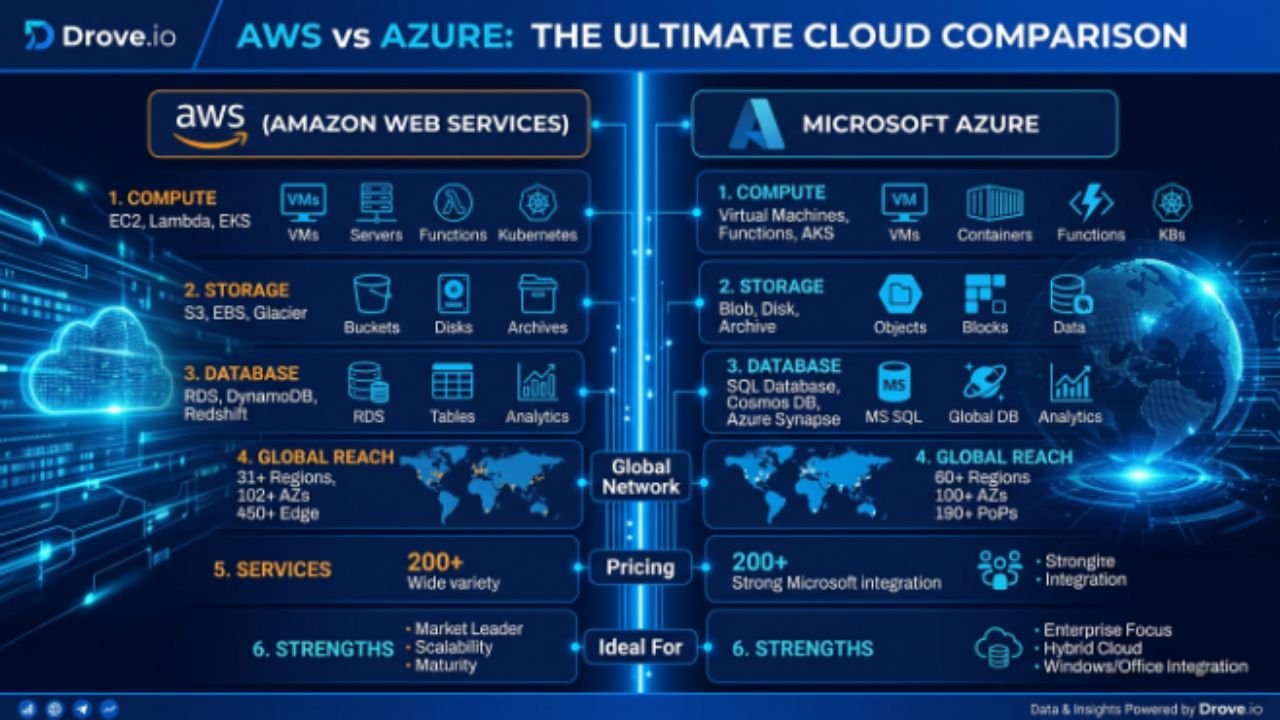
Deciding where to invest your energy in the modern cloud landscape can feel incredibly overwhelming, especially when your financial future hangs in the balance. Choosing the wrong infrastructure can quietly drain your budget, stall your app deployments, and limit your career opportunities before you even get off the ground. Now it’s one of the most Googled topics in the tech world: the droven io aws vs azure comparison. By looking at this match-up through a strategic lens, independent creators and tech professionals can discover which ecosystem offers the shortest path to building a high-yielding, resilient digital asset.
Understanding the deep nuances of a comprehensive droven io aws vs azure comparison matters because cloud architecture is no longer just an IT line item; it is the absolute engine of modern wealth generation. Whether your goal is securing premium remote consulting contracts, scaling a programmatic content network, or deploying autonomous AI workers, the specific environment you master dictates your operating margins and market velocity. Let’s look past the surface-level marketing materials to analyze how these two tech titans stack up when it comes to maximizing your real-world earning potential.
Droven.io AWS vs Azure: Which Cloud will win in 2026? – Introduction
No longer a buzzword for enterprise IT teams, cloud computing is a reality that shapes every corner of the modern web economy. It’s the foundation of nearly all digital businesses, freelance careers, and online income-generating ventures you can imagine in 2026. In fact, the droven io aws vs azure comparison you choose will have a direct impact on how fast you can build your website, how much it will cost, and how much money you can earn from your website in the future, especially if you are a developer, a digital marketer, a content creator, or someone who is building passive income.
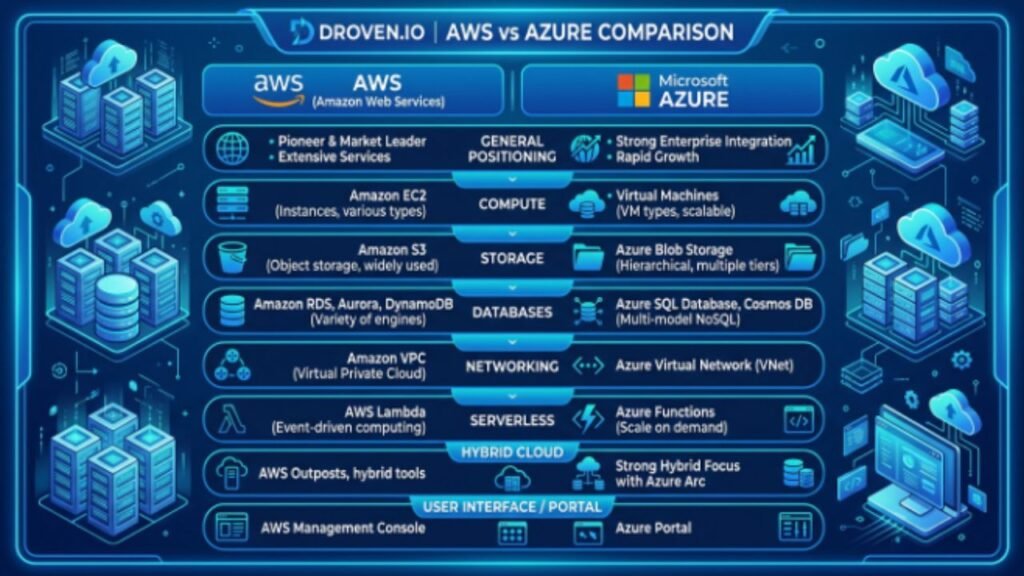
Now it’s one of the most Googled topics in the tech world (and online earning world) of the United States and beyond: the droven io aws vs azure comparison. Droven.io, a continually expanding platform that tracks the latest in tech education trends, AI automation tools, and software development tips, has been watching this trend closely. In this article, we’ll dissect Droven io aws vs azure from a practical, real-world point of view and how this knowledge can actually help you increase your online income in 2026.
Droven io aws vs azure 2026 – What is the big picture?
Amazon Web Services (AWS) was launched in 2006, and ever since, it has dominated the global cloud market with an iron grip. Microsoft Azure arrived later to the game but has been making a massive play in the enterprise space, aggressively capturing clients with existing Microsoft-related investments. This architectural tug-of-war has created two distinct ecosystems, each favoring different development styles, monetization strategies, and corporate environments.
New industry reports show that AWS holds about 31 percent of the cloud market, while Azure commands about 25 percent. Google Cloud is trailing just behind at 11 percent. However, raw market share numbers are not enough to judge the real situation, particularly if you’re looking to get paid to work on the web or develop a line of work in the cloud.
What it really means for the professional and earners in 2026
For independent digital builders, this duopoly means you cannot afford to be passive about your infrastructure choices. The market share split indicates that while AWS gives you access to a broader, highly fragmented market of startups and international projects, Azure opens the doors to deep-pocketed corporate entities. Aligning your skill set with one over the other dictates the exact nature of your client pipeline and your day-to-day development workflows.
Section 1: Freelancing Opportunities in Cloud Computing
AWS and Azure have developed huge freelancing platforms across the global digital economy. These sites such as Upwork, Toptal, and Fiverr are inundated with companies searching for qualified cloud professionals who can build, maintain, and lower hosting expenses. The structural barrier to entry in cloud architecture works to your advantage, keeping competition low and hourly rates exceptionally high compared to more saturated creative niches.
This book takes you through each stage of becoming a cloud freelancer, step by step:
- Pick one platform first! AWS is the recommended solution for startups and clients worldwide. Azure is popular with enterprise and corporate clients, particularly in the U.S. and Europe.
- Get certified. In the tech field, some of the top-paying credentials are AWS Certified Solutions Architect and Microsoft Azure Administrator.
- Build a portfolio. Establish actual projects with free tiers. Document everything transparently.
- Make profiles at Upwork and LinkedIn. Emphasize your qualifications and outcomes over simple task lists.
- Keep contracts small early on. Get your work done quickly, collect your positive feedback, and boost your hourly rates systematically.
The average earning rates for cloud freelancers in the US are between $75 and $150 per hour, depending on their level of certification and experience. This is one of the most realistic and viable online earning avenues that are available at present.
Which Cloud Certification Leads to the Highest Paying Remote Freelance Contracts?
Navigating the sea of technical credentials can feel overwhelming when you are trying to change your financial trajectory. If you choose a certification that lacks market demand, you risk spending months studying for an asset that fails to win client trust or open doors. The right credential acts as an immediate shortcut to authority, validating your technical experience to premium clients who are ready to pay top dollar for infrastructure optimization.
When analyzing the job market data, certain certifications consistently command higher baseline contract values due to the complexity of the environments they cover. Below is a breakdown of how the primary certifications translate into marketplace earnings.
| Certification Tier | Average Hourly Contract Rate | Primary Target Market | Skill Focus |
| AWS Certified Solutions Architect – Professional | $145 – $190 / hr | Well-funded tech startups, global SaaS brands | Multi-tier architecture, cost optimization, migration |
| Microsoft Certified: Azure Solutions Architect Expert | $140 – $185 / hr | Fortune 500 enterprises, healthcare, finance | Hybrid cloud design, enterprise security, active directory |
| AWS Certified DevOps Engineer – Professional | $135 – $175 / hr | Agile development agencies, continuous delivery teams | CI/CD pipelines, automated provisioning, engine scaling |
| Microsoft Certified: Azure Administrator Associate | $90 – $130 / hr | Mid-market corporations, managed service providers | Tenant management, virtual networking, storage compute |
Focusing your efforts on a high-tier path allows you to bypass entry-level competition entirely. It turns your learning hours into an invaluable financial asset that pays continuous dividends.
Section 2: Blogging and Content Creation Around Cloud Platforms
Content around tech education is some of the best content to perform well on platforms such as Droven.io. If you know the core dynamics of a droven io aws vs azure comparison even in an intermediate manner, you can create a blog that will generate regular income from AdSense and affiliate programs as well. High-intent technical queries attract premium advertisers, resulting in incredibly high cost-per-click (CPC) rates.
The topics with good rankings that generate revenue include:
- Detailed comparisons of specific AWS options to Azure options.
- Actionable study guides and practice test breakdowns for cloud certifications.
- Step-by-step DevOps tutorials designed specifically for beginners.
- Creative implementations of artificial intelligence-based automation tools on cloud platforms.
- Comprehensive cost-cutting blueprints for small businesses drowning in hosting fees.
If a blogger writes three in-depth cloud tutorial posts a week, then it is realistic to expect that they will achieve a total of 20,000 monthly visitors in 6 to 9 months. You can generate monthly revenues between $500 to $2,000 without using paid ads by leveraging Google AdSense and high-paying affiliate links to Udemy courses or advanced AWS training programs.
Important takeaway: Use long-tail keywords such as “droven io devops tutorials” or “best cloud tools for developers 2026” to attract targeted search traffic that is more likely to lead to conversions.
Section 3: AI Automation Tools on AWS and Azure
This is where 2026 becomes really interesting for agile internet entrepreneurs. The intersection of artificial intelligence and cloud computing has opened up unprecedented opportunities for non-traditional developers to build highly scalable automated workflows without writing thousands of lines of foundational code.
These are some of the top AWS AI Services to be aware of:
- Amazon SageMaker for creating, training, and deploying machine learning models efficiently.
- Amazon Rekognition for automated image and video analysis workflows.
- AWS Step Functions for orchestrating complex microservices and automated workflows.
- AWS Lambda for running serverless code execution loops in response to real-time events.
Some notable Azure AI Services include:
- Azure OpenAI Service for direct integration of enterprise-grade GPT-based tools.
- Azure Machine Learning Studio for low-code visual model building and deployment.
- Azure AI Speech Services providing highly accurate speech-to-text and voice synthesis.
Industry analysts have been reporting about droven io artificial intelligence news and droven io ai automation tools extensively, and the conclusion is clearanyone who can learn to create simple AI-powered tools on these platforms is taking the high-paying contracts and creating SaaS products with recurring income. There’s no need to be a data scientist. All you need to know is how to connect APIs, create basic workflows, and deploy basic cloud functions to begin earning.
Section 4: Digital Marketing Strategies Using Cloud Infrastructure
Modern digital marketing strategies depend heavily on infrastructure agility, processing speed, and localized data delivery. Marketers who rely purely on shared hosting or basic third-party tools frequently run into scaling walls when handling massive data sets or running high-velocity traffic campaigns.
AWS provides tools like Amazon Pinpoint for highly targeted customer engagement, while Azure features seamless native integrations with Microsoft Advertising and Dynamics 365. As a digital agency or marketing consultant, you gain a massive competitive edge when you master hosting client sites within a droven io aws vs azure comparison framework, handling CDN distribution, and deploying automated pipelines.
Practical example: A freelance digital marketer providing “cloud-hosted landing page setup with AWS” can confidently charge $300 to $800 per project, on top of standard retainers. The technical barrier prevents casual competition from undercutting your business.
How Can Small Businesses Optimize Cloud Infrastructure to Cut Monthly Costs by 40%?
Watching your hard-earned profits vanish into unexpected infrastructure bills is an incredibly frustrating experience for any business owner. Many teams deploy cloud resources during expansion phases without setting strict boundaries, resulting in massive idle costs that quietly chip away at their monthly cash flow. Mastering cost optimization isn’t just about saving pennies; it’s about reclaiming your capital so you can reinvest it directly into growth and marketing.
To stop the bleeding, businesses must approach their resource management with a strict, analytical mindset. Implementing automated guardrails ensures you only pay for what you actually use to power your operations.
| Optimization Action | AWS Native Service | Azure Native Service | Expected Monthly Savings |
| Automated Resource Scheduling | AWS Systems Manager | Azure Automation | 15% – 25% |
| Orphaned Volume Purging | AWS Lifecycle Manager | Azure Backup Management | 8% – 12% |
| Reserved Instance Allocation | AWS Cost Explorer | Azure Advisor | 30% – 60% |
| Serverless Compute Migration | AWS Lambda | Azure Functions | 20% – 40% |
By combining these automated approaches, small enterprises can systematically strip the waste from their accounts. This process keeps your operational footprints lean, highly efficient, and incredibly profitable.
Section 5: Remote Work and Online Jobs in Cloud Computing
The remote employment landscape in 2026 has fundamentally shifted toward specialized technical roles. Corporate entities have realized that maintaining massive physical data centers is an unnecessary risk, accelerating the migration toward multi-cloud setups and remote infrastructure management.
Cloud engineers, DevOps practitioners, and cloud security analysts are being recruited aggressively across the globe to manage these complex environments, commanding full-time remote salaries ranging from $90,000 to $160,000 per year.
Primary platforms to discover premium remote cloud jobs include:
- LinkedIn Remote Jobs for corporate placements and recruiter networking.
- We Work Remotely for tech-first startup engineering roles.
- Remote.co for curated international technical openings.
- Dice.com for specialized United States technology contract positions.
- Glassdoor for transparent salary verification and workplace cultural insights.
One of the top five fastest-growing remote job types currently is a cloud role with AI specialization, which is exactly the core cross-section that Droven.io covers. If you prefer to avoid traditional full-time employment, you can easily secure flexible, high-yield income through specialized contract portals like Toptal or Hired.
AWS vs Azure: Which One Should You Choose in 2026?
Making your final choice requires a clear-eyed assessment of your professional trajectory, your target client profile, and your existing technical background. Entering a market without alignment means fighting an uphill battle against professionals who are naturally suited for that specific ecosystem.
Choose AWS if:
- You want access to the largest possible pool of independent freelance contracts globally.
- Your ideal clients are agile startups, modern SaaS companies, or tech-first direct-to-consumer brands.
- You require the most extensive collection of community-driven documentation, open-source tools, and stack-overflow answers.
- Your new software product is entirely cloud-native and requires a broad array of niche microservices to function.
Choose Azure if:
- Your primary target clients operate within highly regulated legacy industries like healthcare, corporate finance, or government contracting.
- You possess deep familiarity with Microsoft technologies, including Active Directory, Office 365, or the .NET framework.
- Your business model relies on maintaining robust corporate cybersecurity compliance architectures out of the box.
- You are specifically targeting lucrative remote corporate employment within established enterprise firms based in the United States.
According to the latest cloud-based tech education trends published on Droven.io, Azure remains the dominant choice for corporate enterprise learners, while AWS holds a commanding lead among independent software developers and online business builders.
Pro Tips – Droven io aws vs azure
Success in the cloud space requires strategic positioning rather than raw brute force. Implementing small, calculated adjustments to your career or project architecture can radically compound your financial returns over time.
- Tip 1: Stack Your Certifications Strategically. Holding credentials in both ecosystems makes you an incredibly rare and highly sought-after multi-cloud architect. Freelancers with dual capabilities easily command 40% higher contract rates because they can design neutral, cost-effective migrations.
- Tip 2: Exploit the Free Tiers for Real Assets. Both platforms offer 12-month free usage tiers. Do not waste these resource allocations on meaningless practice exercises; use them to deploy live, functional portfolio projects that you can showcase directly to paying clients.
- Tip 3: Focus Intently on Cloud Security. Security infrastructure remains the most underserved and highly lucrative specialization within the modern technology market. Integrating deep security configurations into your standard freelance offerings allows you to upsell your services effortlessly.
- Tip 4: Package and Sell Technical Micro-Courses. You can use lightweight commerce platforms like Gumroad to distribute hyper-focused cloud tutorials. A simple $27 mini-course teaching non-technical founders how to correctly configure an AWS S3 bucket for media storage can generate predictable passive income.
- Tip 5: Launch a Niche Infrastructure Newsletter. Documenting cloud cost-saving tactics or breaking down Azure AI updates in a weekly newsletter builds an incredibly high-value subscriber list. A small audience of 5,000 highly targeted technical professionals can attract premium B2B sponsorships and affiliate payouts.
What Are the Most Common AI Security Vulnerabilities Found in Azure Environments?
As more organizations rush to deploy large language models and automated data processing pipelines, security boundaries are frequently overlooked in the haste of development. This structural rush leaves sensitive corporate training data and proprietary algorithms highly exposed to malicious exploitation. For an independent consultant or engineer, knowing exactly where these structural fractures occur allows you to protect your clients from devastating data leaks and regulatory penalties.
Securing an artificial intelligence deployment requires a deep understanding of how API keys, model endpoints, and internal data stores interact. Below are the most frequent security failures encountered during standard Azure cloud audits.
| Vulnerability Type | Primary Root Cause | Potential Operational Impact | Recommended Native Remediated Tool |
| Exposed OpenAI Endpoints | Lack of strict virtual network binding | Unauthorized model consumption and API billing spikes | Azure API Management (APIM) |
| Misconfigured Key Vaults | Hardcoded credentials within application code | Complete infrastructure tenant compromise | Azure Key Vault + Managed Identities |
| Poisoned Pipeline Access | Unsecured storage accounts holding training data | Compromised model outputs, skewed analytical logic | Azure Blob Storage Private Endpoints |
| Over-Privileged Service Principals | Lax IAM role distribution across development teams | Lateral movement across corporate cloud networks | Azure Role-Based Access Control (RBAC) |
Proactively locking down these specific access vectors ensures your automated workflows remain entirely secure. It safeguards your business continuity and maintains absolute compliance with data protection laws.
Common Mistake students make and how to prevent them!
Avoiding structural pitfalls early in your cloud journey saves you thousands of hours of frustration and prevents costly technical debts that could stall your professional momentum.
- Attempting to master both platforms simultaneously: The single biggest error beginners make is splitting their focus between both environments from day one. This dilution creates immense cognitive friction and stalls your progress. Choose one ecosystem, secure your validation, build a steady income stream, and then expand your horizon.
- Jumping into the freelance marketplace without certification: In the modern economy, clients require immediate, verifiable proof of your capabilities before handing over their infrastructure keys. Skipping your formal credentials means competing on price at the bottom of the market instead of commanding premium authority rates.
- Overlooking real-time billing and cost allocation boundaries: Leaving active, experimental compute instances running unchecked in your accounts can lead to catastrophic billing surprises. Before writing a single line of code or provisioning a database, always configure strict automated billing alarms.
- Launching a technical content asset without an explicit SEO strategy: Building a tech blog without rigorous keyword research means your content will get buried beneath corporate authority sites. You must map your content structure directly to high-intent, low-competition long-tail keywords if you want to capture organic search traffic.
- Delaying your market entry until you feel “completely ready”: The most successful cloud professionals launched their service offerings well before they felt completely flawless. True technical competence is forged through solving real-world, high-pressure problems for actual clients, not by reading textbooks in isolation.
Which Cloud Ecosystem Offers the Fastest Deployment Times for Independent Developers?
Time to market is the lifeblood of any modern digital asset creator or independent software founder. Spending weeks configuring underlying virtual networks, server operating systems, and load balancers can kill your creative momentum and delay critical user feedback. Finding the infrastructure path that strips away configuration friction allows you to test hypotheses quickly and scale your revenue engines without getting bogged down in infrastructure setup.
Evaluating deployment velocity involves looking closely at how each cloud provider structures its application-hosting environments. A streamlined process allows you to push code updates to production seamlessly within minutes.
| Deployment Model | AWS Speed Asset | Azure Speed Asset | Configuration Friction Level | Best Use Case Scenario |
| Containerized Apps | AWS App Runner | Azure Container Apps | Minimal | Microservices, API endpoints |
| Static Web Applications | AWS Amplify | Azure Static Web Apps | Extremely Low | Headless blogs, landing pages |
| Full-Stack Formats | AWS Elastic Beanstalk | Azure App Service | Moderate | Traditional monolithic software |
| Pure Serverless Logic | AWS Lambda | Azure Functions | Low | Event-driven data processing |
Choosing the path that matches your technical skill level keeps you from wasting time on low-level system administration. It lets you direct your energy toward perfecting your user experience and driving conversions.
Frequently Asked Questions – Droven io aws vs azure
In 2026, which is better AWS or Azure for beginners?
AWS is significantly easier to adopt for beginners because its massive global market share has created a vast ecosystem of tutorials, open-source documentation, and entry-level freelance contracts. If you lack a specific corporate target or a prior background in Microsoft development stacks, starting with AWS gives you a much smoother learning curve and immediate access to diverse freelance opportunities.
Is it possible to make money online without a degree using clouds?
Absolutely. The modern cloud economy prioritizes verifiable technical competence and official platform credentials far above traditional academic degrees. Self-taught specialists who build transparent project portfolios and secure professional-level certifications routinely out-earn traditional computer science graduates by focusing on immediate, practical business problems like cost optimization and automated pipeline construction.
How long does it take to get AWS certified?
For an entry-level credential like the AWS Certified Cloud Practitioner, most dedicated students require 4 to 8 weeks of consistent daily preparation. Moving up to professional-tier certifications, such as the Solutions Architect or DevOps Engineer designations, generally requires 3 to 6 months of rigorous, hands-on architectural practice to fully master the complex deployment scenarios.
What is Droven.io & why does it matter?
Droven.io is an authoritative, tech-centric digital publication that delivers deep, actionable insights into AI automation, DevOps frameworks, cybersecurity threats, and emerging tech education patterns. It serves as an essential resource for digital developers and online creators who need to stay ahead of rapid architectural shifts to maintain their competitive edge in the digital economy.
Will it make money to write a blog about AWS or Azure?
Yes, technical blogging within the cloud computing niche is highly lucrative because enterprise software firms, professional training academies, and specialized hosting providers routinely pay exceptionally high ad rates to reach tech buyers. The ad revenue per thousand impressions (RPM) and affiliate conversion payouts in this sector are significantly higher than in general lifestyle or consumer niches.
What are the main differences between AWS and Azure pricing models?
While both ecosystems operate on a fundamental pay-as-you-go model, AWS prices individual storage and data transfer configurations with high granularity, making careful monitoring essential. Azure frequently offers substantial, deeply integrated licensing discounts for businesses that already rely on enterprise Microsoft agreements, making it highly cost-effective for established corporate offices.
Can I run open-source software tools effectively on Microsoft Azure?
Yes, Microsoft has completely transformed its approach to open source over the past decade, ensuring that Linux distributions, Kubernetes environments, and popular open-source databases run with native efficiency across Azure infrastructure. You are no longer restricted to Windows-centric environments when building on Azure tools.
Droven io aws vs azure – Conclusion
The structural analysis of a droven io aws vs azure comparison reveals that your choice should not be guided by which platform claims technical supremacy. Instead, it must be guided entirely by your precise financial objectives, your target audience, and the nature of the digital assets you intend to construct. AWS and Azure are truly powerful, robust, and in-demand environments for 2026.
The most profitable strategy is to choose one platform with absolute conviction, master its core architectural mechanisms, and begin deploying live assets that solve real business problems. As the digital workplace continues its rapid evolution, proactive cloud professionals who hold specialized infrastructure skills will always outpace the general market. Begin with a single strategic certification, construct one authentic portfolio asset, and secure your first high-paying clientthat is exactly where sustainable digital wealth creation begins.

Alex Carter is a technology writer covering AI, software, cybersecurity, and digital trends, delivering expert insights and practical guides.