
You built something from nothing. No seed check, no rich uncle, no warm intro from a college roommate who “knows a guy at Sequoia.” Just you, a laptop, and a stubborn refusal to quit even when the bank balance said otherwise.
Now you’re staring at a decision that feels bigger than the one that got you here. Should you raise money at all? And if you do, how do you pitch a startup booted fundraising strategy without sounding like you’re apologizing for not raising sooner? This guide walks you through the honest version, the one built for founders who booted their company with grit instead of a term sheet, so you can raise on your terms and keep the mindset that got you this far.
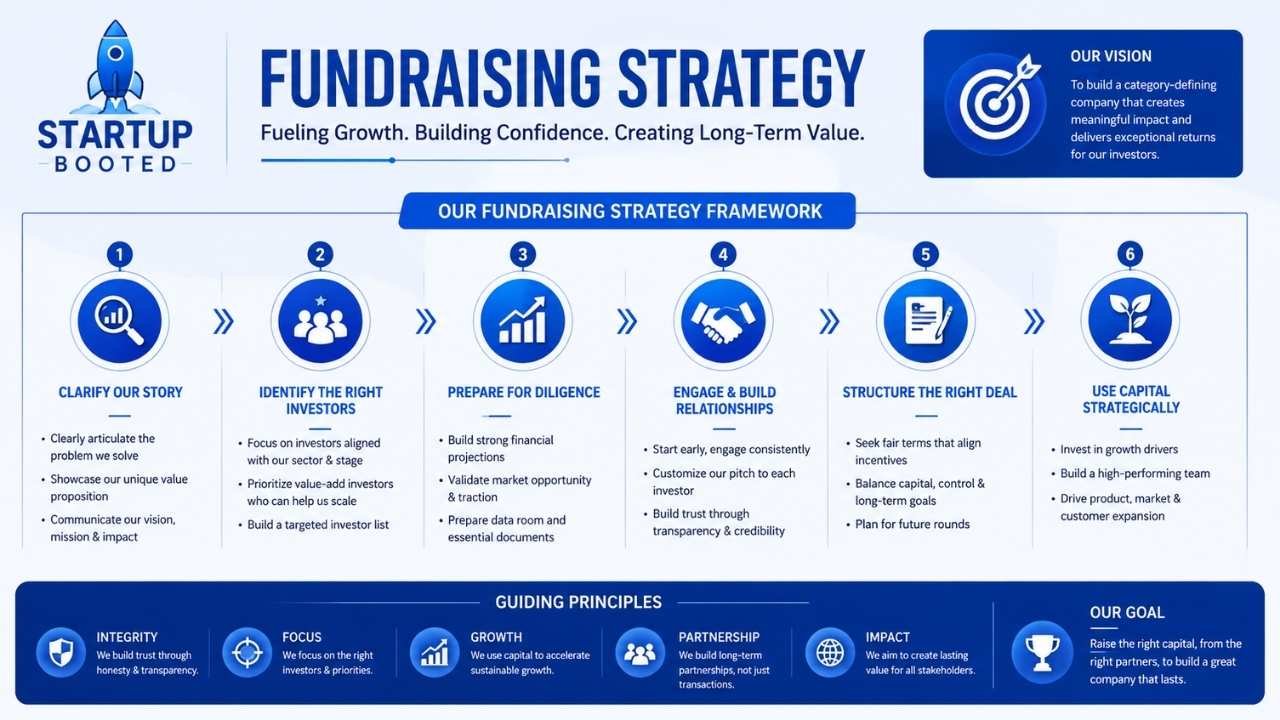
Startup Booted Fundraising Strategy
A startup booted fundraising strategy isn’t a rebrand of the standard VC playbook. It’s a completely different approach built around one truth: you have real revenue, real customers, and real discipline instead of a shiny deck and a big TAM slide. That’s your leverage, not your liability.
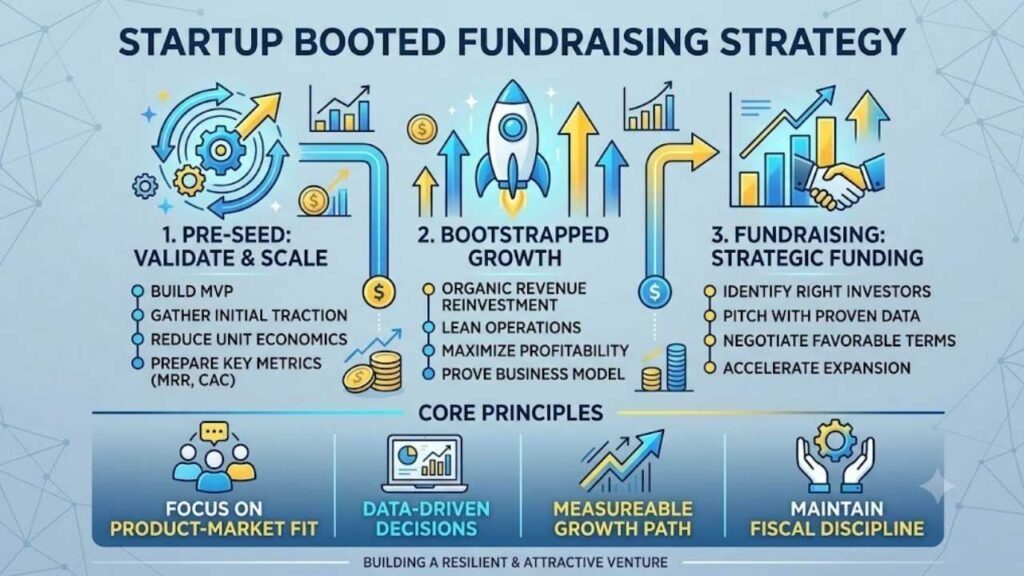
Here’s what makes this approach different from a typical pre-seed raise:
- Traction replaces narrative as your main selling point
- Capital efficiency becomes a headline metric, not a footnote
- Investor targeting matters more than investor volume
- Your booted origin story becomes marketing, not a disclaimer
- Valuation strategy has to account for investor bias against unfunded founders
Founders who treat this as “regular fundraising, but I have less runway” tend to burn months chasing the wrong people. Founders who treat it as its own discipline tend to close faster, at better terms, with investors who actually understand the business.
First, Let’s Be Honest: Most Booted Startups Shouldn’t Raise
Before you write a single line of your deck, ask whether raising is even the right move. Plenty of booted founders raise out of anxiety, not strategy, and regret it within a year.
If your business already pays your bills and grows steadily without outside capital, venture money can actually hurt you. Investors expect 10x outcomes, and a healthy, profitable business that grows 20% a year looks like a failure through that lens.
Ask yourself these questions honestly before moving forward:
- Are we leaving revenue on the table because we can’t build fast enough?
- Is a well-funded competitor actively eating our market share?
- Do we need one specific senior hire we genuinely can’t afford right now?
- Am I burned out after already optimizing every operational lever available?
| Situation | Should You Raise? |
| Profitable, steady growth, happy team | Probably not |
| Competitor pressure, clear revenue ceiling | Yes, consider it |
| Need one critical hire to unlock growth | Yes, or try non-dilutive first |
| Burnout with no more levers to pull | Talk to advisors before deciding |
If you answered yes to at least three of the pressure points above, you have a real case. If not, a small business loan or a revenue-based advance might serve you better than giving up equity for a “merit badge.”
The “Booted” Advantage That VCs Secretly Love
Bootstrapping from zero teaches skills that venture-backed founders often never develop, and sharp investors know it. Your startup booted history is quietly one of your strongest selling points once you learn to frame it correctly.
Here’s what you actually walk in with that a freshly-funded founder doesn’t:
- You learned to sell face-to-face because ad budgets weren’t an option
- You developed real capital efficiency since every dollar had to earn its place
- You built genuine resilience from near-zero runway and lost customers
- You know your unit economics cold, not from a spreadsheet template
- You’ve already validated product-market fit without outside pressure
Instead of saying “we haven’t raised before,” reframe it. Try something closer to: “We booted this company on personal savings and turned it into meaningful ARR. Imagine what real capital does next.” That single shift changes how an investor hears the rest of your pitch.
What Makes a Booted Startup Attractive to Investors?
Investors who understand lean operations actively seek out booted founders because the risk profile looks different. Startup booted teams tend to burn less and convert every dollar of capital into measurable output.
A few reasons smart investors lean in rather than away:
- Lower burn rate compared to funded competitors at the same stage
- Proven demand validated by paying customers, not projections
- Disciplined hiring habits that reduce dilution over time
- Founders who already know how to say no to vanity spending
- A team that treats every check as fuel, not oxygen
Example in chat: Founder: “We’re at $18k MRR, growing 22% monthly, and we’ve never taken outside money.” Investor: “That’s exactly the kind of efficiency I look for at this stage.”
The Metrics That Matter for a Booted Founder (Hint: Not Hype)
Venture-backed startups often raise on vision and team pedigree. As a booted founder, you raise on traction and efficiency instead, so your numbers need to do the heavy lifting your network can’t.
Here’s roughly what investors expect to see at each stage of a startup booted fundraising strategy:
| Metric | Angel Check ($100k-$300k) | Seed Round ($500k-$1.5M) |
| Monthly Recurring Revenue | $5k-$10k | $20k-$50k |
| Month-over-month growth | 10%-15% | 20%+ |
| Gross margin | 70%+ | 80%+ |
| CAC payback period | Under 12 months | Under 6 months |
| Net dollar retention | 100%+ | 110%+ |
| Runway without new capital | 6 months | 9+ months |
If your numbers sit below this range, resist the urge to raise an equity round right away. You’ll get crushed on valuation. A revenue-based financing bridge or a small convertible note often makes more sense until your metrics catch up.
Startup Booted Fundraising Strategy: Timing Your First Raise Right
Timing determines whether your startup booted fundraising strategy feels like leverage or desperation. Raise too early, and you’ll give away far more equity than the business warrants.
A few signals that your timing is actually right:
- You’ve hit at least $5k-$10k MRR with consistent growth
- Your churn rate has stabilized below industry norms
- You have a specific use of funds tied to measurable outcomes
- A competitive threat or market window is closing fast
- You can point to 12+ months of data, not just a few good weeks
One founder I know booted an edtech tool to $8k MRR with 18% monthly growth. VCs told him to come back at $20k MRR. Instead, he took a $150k revenue-based advance, hired a growth marketer, hit $25k MRR within seven months, then raised over a million dollars at a much stronger valuation. That’s timing working in his favor.
Where to Find Investors Who Actually Like Booted Founders
Most VCs carry an unspoken bias toward founders who already raised before, treating prior funding as a proxy for outside diligence. Your startup booted approach needs to be surgical rather than a mass blast to every fund on a list.
1. Angels who booted their own companies
Search LinkedIn and Twitter for phrases like “bootstrapped to acquisition.” These people already understand what you went through and rarely ask condescending questions about why nobody funded you sooner.
2. Micro VCs (funds under $50M)
Smaller funds need smaller exits, often in the $30M-$80M range. An efficient, growing, startup booted business is a strong fit here. Larger funds chasing unicorns will usually pass regardless of your metrics.
3. Revenue-based financing (RBF) providers
Platforms offering revenue-based financing advance you months of future revenue without taking equity. Use that capital to hire one key person, prove acceleration, then raise equity later from a position of strength.
4. Your own customers
Email your top ten customers directly and ask if they’d invest a small amount in your next round. Many will say yes, and their participation signals product-market fit to every other investor watching.
Steer clear of mega-funds that claim to be “stage agnostic” but only write seven-figure checks. Chasing them wastes months on intro calls that lead nowhere.
How to Build a Fundraising Pipeline as a Booted Startup
A scattershot approach kills momentum fast, so your startup booted fundraising strategy needs an actual pipeline, not a random list of names you found on Twitter.
Structure your outreach like a sales funnel:
- Build a list of 50-100 targeted investors matching your stage and thesis
- Segment them into warm, lukewarm, and cold categories
- Track every touchpoint in a simple spreadsheet or CRM
- Set a weekly quota for new outreach and follow-ups
- Prioritize investors who’ve backed similar booted founders before
| Pipeline Stage | Weekly Target | Goal |
| New outreach | 10-15 investors | Fill the top of funnel |
| First meetings | 5-8 calls | Test your pitch |
| Follow-ups | 100% response rate | Keep momentum alive |
| Term sheet conversations | 2-3 serious | Close within 60-90 days |
Treat fundraising like a sales process with a defined close date. Investors sense urgency, and a startup booted founder with a clear timeline closes faster than one drifting through open-ended conversations.
Building Investor Momentum Without a Warm Intro
Not having a network isn’t disqualifying, it just means you build one in real time as part of your startup booted fundraising strategy.
Try this sequence over roughly 90 days:
- Publish a public narrative post about your growth and your ask
- Attend free accelerator office hours even without being enrolled
- Send cold emails with specific metrics, never generic asks
- Secure one credible angel early to create social proof for others
Example in chat: You: “Booted to $18k MRR, 20% MoM growth, raising $600k. Would love 10 minutes even if it’s not a fit.” Investor: “This is exactly the kind of specific ask I respond to. Let’s talk Thursday.”
Short, data-rich outreach consistently outperforms long, emotional pitches when you’re starting from zero network.
Valuation, Dilution, and the “Booted Tax”
Here’s an uncomfortable truth: booted startups often raise at lower valuations than venture-backed peers, even when their metrics are stronger. Investors assume that if you were truly exceptional, someone would have funded you already. It’s not fair, but it’s the reality of this game.
Typical pre-seed valuation ranges look something like this:
| MRR | Booted Startup Valuation | VC-Backed Peer Valuation |
| $5k | $2M-$3M | $4M-$6M |
| $15k | $4M-$6M | $7M-$9M |
| $30k | $6M-$8M | $10M-$12M |
That gap, often 20%-30% lower, is what founders informally call the booted tax. You minimize it by proving capital efficiency louder than anyone else in the room.
For a $500k-$1.5M raise, most booted founders give up somewhere between 5% and 12% equity. Anything past 15% deserves serious scrutiny unless the investor brings a major strategic customer or executive hire alongside the check.
Should You Raise a Priced Round or a SAFE as a Booted Founder?
This question comes up constantly in every startup booted fundraising strategy conversation, and the answer usually favors flexibility over certainty.
A few points to weigh before deciding:
- SAFE notes delay a fixed valuation until a later, likely higher, round
- Priced rounds lock in your number immediately, for better or worse
- SAFEs close faster with less legal overhead and lower costs
- Priced rounds make more sense once you’re past $1M ARR
- Booted founders usually benefit from waiting on valuation, not fixing it early
Most advisors recommend SAFEs for anyone raising below $1M ARR, simply because your valuation trajectory is still climbing fast enough to make a fixed price risky.
The 10-Slide Deck for Booted Founders
Your deck isn’t a novel, and a startup booted fundraising strategy deck looks noticeably different from a typical VC pitch deck.
Here’s the exact structure that works:
- Title slide: “Booted from $0 to $X MRR, raising $Y to accelerate”
- Problem and solution: kept tight, no fluff
- Traction slide: your hero slide, showing growth and capital efficiency
- Why now: competitive pressure or market timing, stated plainly
- Team slide: highlighting skills built through bootstrapping directly
- Use of funds: specific line items, not vague categories
- Ask slide: exact terms, cap, and closing timeline
Skip product screenshots on every slide, skip the culture slide, and skip generic customer quotes. Investors reading a startup booted deck want data and narrative, nothing decorative in between.
Common Mistakes Booted Founders Make When Pitching Investors
Even strong booted founders stumble in predictable ways once they finally sit across from an investor. Recognizing these mistakes early saves you months of wasted meetings.
Watch out for these patterns:
- Apologizing for not raising sooner instead of owning the story
- Pitching too many investors outside your actual stage or thesis
- Hiding weak metrics instead of addressing them head-on
- Sending generic outreach emails with no specific data points
- Accepting the first term sheet without comparing alternatives
- Underestimating how long legal and diligence actually take
Example in texting: Friend 1: bro I just sent the same email to 200 investors Friend 2: that’s why nobody’s replying, personalize it or don’t bother
The Red Flags You’ll Get – And How to Answer
Investors throw a handful of predictable objections at every startup booted fundraising strategy pitch. Preparing your answers in advance keeps you calm and credible in the room.
- “You’re too small, come back later.” Show your 12-month roadmap with and without their capital, then ask which version looks better to them.
- “Your valuation seems high for a booted startup.” Compare unit economics directly against funded peers using your actual CAC payback and retention numbers.
- “Why hasn’t anyone invested before now?” Explain that you deliberately avoided raising to prove product-market fit without distraction, and offer to share your retention cohort data.
Stay composed, treat every objection as a teaching moment about your business, and never get defensive when skepticism shows up.
How Long Does a Startup Booted Fundraising Strategy Take to Execute?
Timelines vary, but most booted founders underestimate how long the full process actually takes from first outreach to wired funds.
A realistic breakdown looks like this:
- Weeks 1-4: Building your pipeline and sending initial outreach
- Weeks 4-8: First meetings and refining your pitch based on feedback
- Weeks 8-12: Serious term sheet conversations and negotiation
- Weeks 12-16: Legal diligence, documentation, and closing
Expect the full cycle to run 90 to 120 days at minimum, even when momentum feels strong early on. Founders who plan for this timeline avoid the panic that comes from assuming a two-week close.
Term Sheet Basics Every Booted Founder Should Know
Once an investor sends a term sheet, your startup booted fundraising strategy shifts from pitching to negotiating, and this stage carries real long-term consequences.
Key terms worth understanding before you sign anything:
| Term | What It Means | Why It Matters |
| Valuation cap | Ceiling price for conversion | Protects you from later dilution |
| Discount rate | Reduced price versus next round | Rewards early investor risk |
| Pro-rata rights | Right to invest in future rounds | Can affect future cap table |
| Board seats | Investor governance control | Impacts decision-making speed |
| Liquidation preference | Payout order in an exit | Affects founder proceeds at sale |
Bring in a startup-savvy lawyer before signing, even for a simple SAFE. The cost upfront is far smaller than the cost of a bad term buried three pages deep.
After You Raise: Don’t Lose the Booted Mindset
The moment funds hit your account, a dangerous shift often begins. Founders start thinking like a “real CEO” and reach for a bigger office, fancier tools, and a much larger team almost overnight.
Resist that instinct. The strongest post-raise booted founders keep their scrappy habits intact:
- They keep the same small team for three to six months after closing
- They use new capital to accelerate what’s already working
- They still track cash weekly and question small recurring expenses
- They set up an informal advisory board focused on operational discipline
One founder raised over a million dollars after booting to $35k MRR. She hired a single senior engineer and put the rest into paid acquisition. Revenue tripled within a year, simply because she fed an already-working engine instead of building a new one from scratch.
What If You Don’t Raise at All?
A startup booted fundraising strategy doesn’t always end in raising money, and that’s worth remembering before you commit months to the process.
Revenue-based financing, small business loans, grants, and customer prepayments can all fund growth without touching your equity. Reaching several million in ARR without outside capital builds a genuinely valuable business, one you can sell, hold, or eventually raise for on your own terms later.
Frequently Asked Questions
What exactly is a startup booted fundraising strategy?
It’s an approach for founders who built their company with little outside capital and are now raising for the first time, focused on efficiency and targeted investor outreach.
When should a booted startup start fundraising?
Most advisors suggest raising once you hit $5k-$10k MRR with steady growth and a clear reason you can’t reach the next milestone alone.
How do I find investors for a booted startup without a network?
Target angels who bootstrapped themselves, micro VCs, and revenue-based financing providers, then use cold email with specific, data-rich subject lines.
What valuation should I expect as a booted startup?
Expect roughly 20%-30% lower valuations than funded peers at similar metrics, often called the booted tax within founder circles.
How much equity should I give up in my first round?
Most booted founders give up between 5% and 12% equity for a $500k-$1.5M raise, with anything above 15% deserving real scrutiny.
What’s the biggest mistake booted founders make after raising?
They lose operational discipline by hiring too fast and abandoning the scrappy habits that made their startup booted journey successful in the first place.
Can I raise without giving up equity at all?
Yes, revenue-based financing, loans, grants, and customer prepayments offer non-dilutive paths that suit many booted businesses well.
Conclusion
Building a company from nothing isn’t a weakness you need to explain away, it’s the foundation of a real startup booted fundraising strategy that investors increasingly respect. The playbook here isn’t about pretending to be something you’re not. It’s about owning your scrappy history, treating efficiency as a weapon, and finding the specific investors who understand exactly what you’ve built.
You’ll hear more no’s than yes’s along the way, and some conversations will go nowhere. But founders who’ve already proven they can survive with nothing tend to be the ones who build companies that last. Whether you raise a round or bootstrap further, keep the startup booted mindset that got you this far, and keep building either way.

Alex Carter is a technology writer covering AI, software, cybersecurity, and digital trends, delivering expert insights and practical guides.