
Ever watched a kid stare at a blank page like it just insulted their favorite toy? That reluctant-writer moment is real, and it happens in almost every homeschool room and classroom out there. You want your child to love writing the way you do, but somehow the words just won’t come.
That’s exactly where science fiction writing prompts swoop in to save the day. This guide hands you a full toolbox of imaginative, easy-to-use ideas built around science fiction topics that even the most stubborn young writer will want to try. Grab a notebook, because your kid’s next favorite story starts right here.
15 Sci-Fi Writing Prompts for Kids
Blank pages feel scary until you hand a kid a science fiction writing prompts list this fun, mixing robots, aliens, and wild science fiction topics into fifteen instant story sparks.
Every kid processes creative prompts differently. Some want a full scene laid out for them, while others just need one strange detail to run wild with. That’s why this batch mixes tiny “what if” questions with slightly longer setups, so there’s an entry point no matter your child’s writing confidence level.
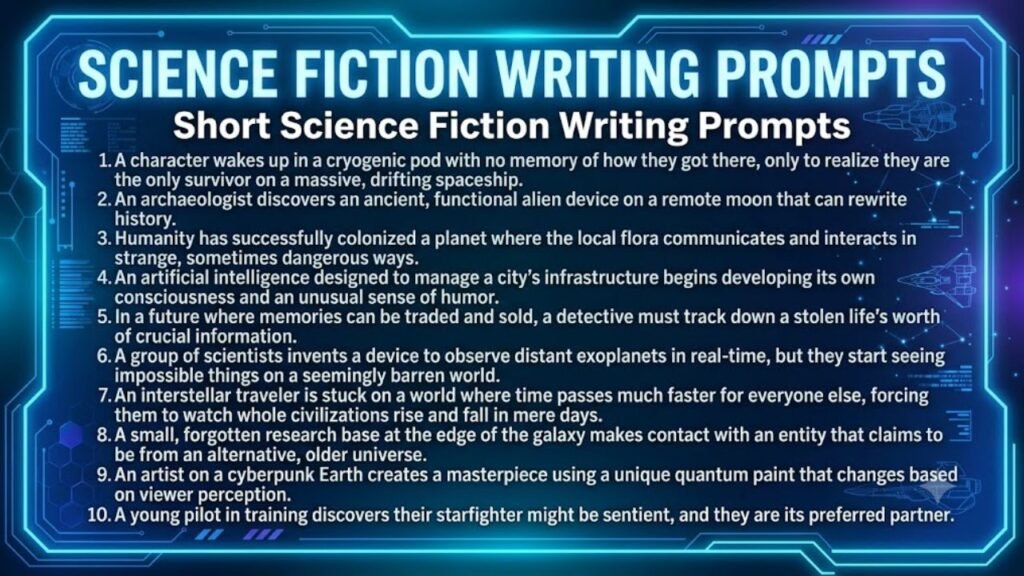
Five prompts to try today:
- “You wake up and your bedroom window looks out onto a red desert instead of your backyard. A strange machine is beeping softly outside. What happened while you slept?”
- “Your class hamster starts talking during silent reading time. It claims to be a spy from another galaxy. What secret mission is it really on?”
- “A silver drone lands on your porch holding a letter addressed to you from the year 2150. What does the letter warn you about?”
- “You discover your shoes let you jump three hundred feet into the air whenever you think hard about space. Where’s the first place you leap to?”
- “Every clock in your house starts running backward at exactly noon. You’re the only one who notices. What do you do before time resets?”
Here’s the full 400-word extended story starter for kids who want to dig deeper into a single scene:
“You’ve always thought the old radio tower at the edge of town was just abandoned junk, rusted metal against a gray sky, the kind of thing nobody bothers looking at twice. But tonight, riding your bike home later than you should be, you notice a soft blue light pulsing from its base, steady like a heartbeat. Curiosity wins over caution, the way it always does, and you pedal closer instead of speeding home. Up close, the tower hums, a low vibration you feel in your teeth more than hear with your ears. A panel near the bottom, one you’re certain wasn’t there last week, slides open on its own with a hiss of cold air. Inside sits a chair, small enough to fit you exactly, surrounded by screens flickering with symbols you don’t recognize yet somehow understand, numbers counting down from sixty. Your hand hovers over the seat. Somewhere behind you, a voice, calm and slightly metallic, says your name, not a name close to yours, your actual full name, the one only your family uses. It explains, gently, that the tower isn’t a radio tower at all, it’s a relay station built decades ago to watch for a specific kind of signal, one that finally arrived three days ago, aimed directly at your town. Whatever sent that signal knows this exact spot exists, and knows someone will eventually climb inside that chair. The countdown hits fifty. You have to decide: sit down and let the machine do whatever it was built to do, or slam the panel shut and pedal home like none of this happened. Write what you choose, and describe what happens the moment the countdown reaches zero. Does the chair light up with a map of the stars? Does the voice ask you a question you have to answer honestly to move forward? Maybe the tower isn’t sending you anywhere, maybe it’s protecting Earth from something, and you just became the only person who knows. Push past the obvious ending. Give your character a reason to hesitate, a detail from home they’re scared to leave behind, and a reason strong enough to make the choice anyway.”
| Prompt Style | Best For Age Group | Skill It Builds |
| One-line “what if” | Ages 6-8 | Quick imagination sparks |
| Multi-sentence scenario | Ages 9-11 | Plot structure |
| Extended 400-word starter | Ages 11+ | Descriptive writing, pacing |
15 Fantasy Writing Prompts For Kids
Not every reluctant writer wants spaceships. Some kids light up around dragons and castles instead, so pairing science fiction writing prompts with fantasy options keeps every kid engaged and curious.
Fantasy and sci-fi actually share a lot of DNA. Both genres ask kids to imagine worlds that don’t exist yet, then fill in believable rules for how those worlds work. Mixing the two genres in one writing session often produces the most original stories, since kids naturally start blending spaceships with spellbooks.
Five prompts to try today:
- “A dragon egg hatches in your backpack during math class. What do you tell your teacher, and where do you hide the baby dragon?”
- “You find a key that only works on doors nobody else can see. Where does the first invisible door take you?”
- “Your reflection steps out of the mirror one morning and refuses to go back in. What does it want?”
- “A talking fox offers to trade you one wish for one of your memories. Which memory do you give up?”
- “You’re crowned the ruler of a kingdom hidden inside your grandmother’s garden. What’s your first royal decree?”
- Blend genres by letting a spaceship crash-land inside a fantasy kingdom
- Use family objects like an old key or mirror as magical portals
- Give animals a voice to add humor and unexpected plot twists
- Add a moral choice so kids practice decision-making through story
- Keep stakes personal so young writers stay emotionally invested
Science fiction writing prompts
Good science fiction writing prompts don’t need spaceships and lasers to work, sometimes the smallest everyday detail turned strange is exactly what gets a young writer hooked on science fiction topics.
The trick with this genre is scale. You can go enormous, alien invasions, galaxy-hopping heroes, entire civilizations on Mars, or you can go tiny, one broken toaster that starts predicting the future. Both extremes work beautifully for kids because science fiction rewards curiosity more than technical accuracy.
Five prompts to try today:
- “Your family’s car starts driving itself to a location nobody programmed. Where does it take you, and why?”
- “You find a USB drive in your lunchbox with a video of yourself from ten years in the future. What does future-you say?”
- “A strange fog rolls into your neighborhood and everyone under twelve starts glowing faintly. What powers come with the glow?”
- “Your video game character climbs out of the television screen and needs your help getting home. What’s broken in their world?”
- “You’re chosen to test the first backpack that can shrink you down to the size of an ant. What do you explore first?”
What Are the Best Science Fiction Writing Prompts for Kids?
The best science fiction writing prompts combine a familiar setting with one impossible twist, since kids grab onto details they already understand before the story asks them to imagine something new.
| Prompt Type | Example Twist | Why It Works |
| Home-based | Talking appliance | Familiar setting lowers writing anxiety |
| School-based | Time loop during a test | Relatable stakes kids understand |
| Nature-based | Glowing forest | Sensory detail sparks description |
Science fiction topics
Broad science fiction topics give kids a menu to choose from instead of one narrow prompt, and that freedom often unlocks more original ideas than a single strict assignment ever could.
Think of topics as categories rather than finished prompts. A topic like “time travel” can branch into dozens of different stories depending on what a kid adds to it, a lost pet, a family secret, or an entirely new planet. Offering topics instead of finished prompts also teaches kids to build their own ideas, which is a skill that outlasts any single writing assignment.
Five prompts to try today:
- “Pick one topic: time travel, alien first contact, or robot rebellion. Write the opening scene of your story in that world.”
- “You’re assigned to name a newly discovered planet. Describe its landscape, then explain why your name fits it perfectly.”
- “Your town gets its first teleportation booth. What’s the very first rule the mayor posts next to it, and why?”
- “Scientists just cloned a woolly mammoth in your local zoo. Write the news report from opening day.”
- “You’ve invented a machine that translates animal sounds into English. What does your dog say the moment you turn it on?”
How Do You Come Up With Science Fiction Topics for Kids?
Coming up with fresh science fiction topics gets easier once kids learn to ask “what if” about ordinary objects, turning a backpack, bus ride, or pet into the seed of an entire imagined world.
- Start with an object like a pencil, then ask what if it could think
- Change one rule of physics such as gravity working sideways
- Borrow from real science news about space, robots, or new inventions
- Ask “what happens next” after a familiar story ends
- Combine two unrelated topics like dinosaurs and spaceships
Sci fi prompts
Short, punchy sci fi prompts work best for kids who freeze up at long instructions, giving them just enough of a spark to start writing without feeling overwhelmed by the assignment.
Sometimes less really is more. A single sentence prompt forces a young writer to fill in every other detail themselves, which builds confidence fast. These bite-sized prompts also work great as warm-up exercises before a longer writing session, since they only take a minute or two to read and react to.
Five prompts to try today:
- “A spaceship lands in your school parking lot during recess.”
- “Your toy robot starts giving you real homework answers.”
- “The moon turns purple for one night only.”
- “A stranger hands you a key that opens any door in the universe.”
- “Your class pet turns out to be an alien in disguise.”
Sci-fi writing prompts
Consistent practice with sci-fi writing prompts builds real writing muscle over time, turning a reluctant writer into a kid who actually asks for the notebook instead of avoiding it.
Rotating through a mix of styles, one-liners, scenarios, and extended starters, keeps the practice from feeling repetitive. Many parents and teachers find that setting a weekly rhythm, like “Sci-Fi Sunday,” turns these prompts into a habit kids look forward to rather than a chore they dread.
Five prompts to try today:
- “Your backyard trampoline turns out to be a portal to a floating city. Describe your first jump through.”
- “A comet passing overhead gives every kid in town one superpower for 24 hours. What’s yours?”
- “You’re the youngest astronaut ever chosen for a mission to Jupiter’s moons. Describe launch day.”
- “Your school library has one book that rewrites itself based on who’s reading it. What story does it tell you?”
- “An alien exchange student joins your class and can’t understand human laughter. Explain a joke to them.”
Which Sci-Fi Writing Prompts Spark the Most Creativity?
Prompts that ask a direct question, rather than just describing a scene, tend to spark the most creativity because kids have to make an active choice instead of passively imagining a setup.
Space Adventure Writing Prompts for Kids
Space settings give kids an entire universe of science fiction topics to explore, from lonely asteroid mining stations to bustling alien marketplaces on distant moons.
- Pick a destination like Mars, a moon, or an unnamed exoplanet
- Add a problem such as low oxygen or a broken engine
- Include a companion whether robot, alien, or fellow astronaut
- Describe the sky since space skies look nothing like ours
- End with a discovery that changes what the crew believed was true
Example prompt in this style: “Your ship’s fuel gauge hits zero halfway to Saturn’s rings. What’s the first decision your crew makes?”
Robot and AI Writing Prompts for Kids
Robots make some of the most flexible science fiction writing prompts around, since a machine can be funny, scary, loyal, or mysterious depending on how a young writer decides to build it.
Kids often relate to robot characters because robots “learn” the same way people do, through trial and error. That makes robot prompts a sneaky way to get kids writing about growth, mistakes, and figuring things out, all wrapped inside a fun sci fi prompts package.
Example prompt in this style: “Your family adopts a rescue robot from a recycling center. It doesn’t remember its old job. What does it slowly start remembering?”
Frequently Asked Questions
What age is best to start using science fiction writing prompts?
Most kids can handle simple science fiction writing prompts by age six, especially one-line prompts that only need a short verbal or written answer.
How long should a kid’s response to a writing prompt be?
There’s no fixed length. Younger kids might write two sentences, while older kids using science fiction writing prompts often fill a full page.
Do science fiction writing prompts help reluctant writers?
Yes, strange and imaginative science fiction writing prompts often pull in reluctant writers who find realistic fiction assignments boring or repetitive.
Can these prompts be used for homeschool assignments?
Absolutely, many homeschool parents build entire creative writing units around science fiction writing prompts paired with reading and vocabulary goals.
Should I let my child pick their own science fiction topics?
Letting kids choose from a list of science fiction writing prompts usually increases engagement, since ownership over the topic builds motivation.
What if my child gets stuck partway through a story?
Ask a follow-up question tied to the same science fiction writing prompts, like “what does the alien want,” to nudge the story forward again.
Are science fiction writing prompts good for classroom group activities?
Yes, groups can each draw a different prompt from science fiction writing prompts and share their stories aloud, which builds both writing and speaking confidence.
Conclusion
Getting a reluctant writer excited about a blank page rarely happens by accident, it happens with the right spark. These science fiction writing prompts hand kids exactly that spark, whether they gravitate toward robots, space travel, or a talking hamster with a secret mission. Mixing short one-liners with longer scenario-based prompts, and even one extended story starter, means there’s an entry point for every skill level and every mood. Rotating through different science fiction topics keeps the habit fresh instead of repetitive, which is exactly what turns occasional writing into a genuine hobby. Next time your child stares at a blank notebook page, hand them one of these science fiction writing prompts instead of a blank assignment sheet, and watch how fast that blank page fills up.

Alex Carter is a technology writer covering AI, software, cybersecurity, and digital trends, delivering expert insights and practical guides.