
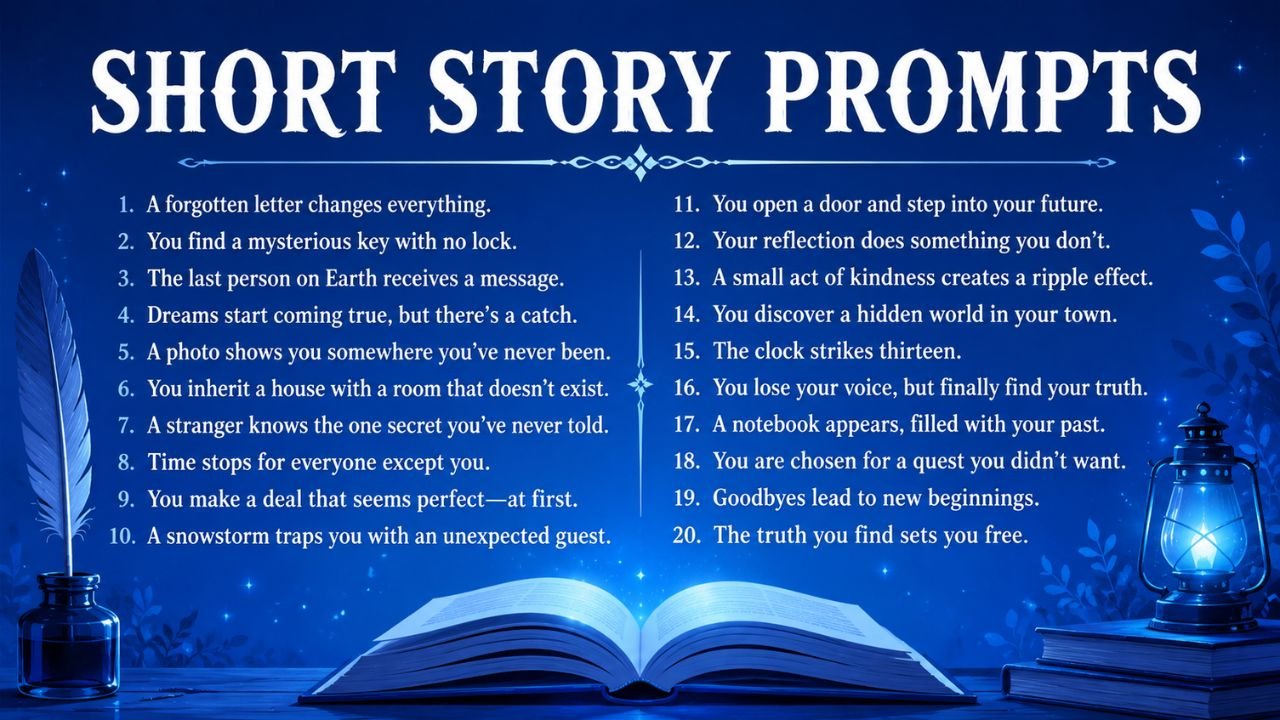
You know that feeling when you sit down to write and your mind just… goes blank? You want to tell a story, you have the time carved out, and yet nothing comes. It’s not a lack of talent. It’s a lack of a spark, and that’s exactly where short story prompts earn their keep.
This guide gives you a full year’s worth of ideas, genre-specific angles, and practical ways to actually finish what you start. Whether you’re chasing a daily habit or just need one good short story writing prompts list to break a slump, you’re in the right place. Let’s get your pen moving.
Writing prompts for short stories
Every writer hits a wall at some point, and that wall usually isn’t about skill. It’s about momentum. A blank page has no starting point, but a prompt hands you one instantly.
Short story prompts work because they narrow infinite possibility down to something manageable. Instead of “write a story,” you get “a broken watch, a peppermint, and a hug that goes too far.” That specificity is a gift, not a limitation.
- Reduce decision fatigue by giving you a fixed starting point
- Build a writing habit through consistent, low-pressure practice
- Stretch your range into genres or tones you wouldn’t normally try
- Beat perfectionism since a prompt-based draft feels lower stakes
- Generate a backlog of ideas you can develop later into longer work
Writers who commit to a weekly prompt routine often notice their instincts sharpen fast. You stop waiting for inspiration and start treating writing like a craft you show up for, not a mood you wait on.
What Makes a Good Short Story Prompt?
A strong prompt does one job well: it gives you tension without dictating the ending. The best short story prompts leave room for surprise, which is exactly what keeps a story feeling alive on the page.
- Specific objects ground the story in something concrete and visual
- Unanswered questions create built-in curiosity for the writer
- Emotional stakes give the character something real to lose
- Open endings let you decide where the conflict actually goes
- Genre flexibility means one prompt can become five different stories
| Prompt Type | Example | Why It Works |
| Three-object prompt | A cup of coffee, a skateboard, your ex | Forces unexpected connections |
| First-line prompt | “Her face went still as the glass shattered.” | Drops you mid-scene instantly |
| Scenario prompt | A stranger hands you $1,000 and a letter | Built-in conflict and stakes |
| Character prompt | A monster works at a post office | Invites tone and voice play |
Example in practice: Take one object, one place, and one secret. That trio alone is often enough to carry a full 1,500-word draft.
52 Writing Prompts
If you want a full year of material, a rotating list of 52 writing prompts gives you one fresh idea every single week. That rhythm is manageable even for busy writers, and it removes the “what do I write about” question entirely.
Here’s a sampling to get your year started:
- A hidden talent, an attic, and the sky above it
- A polaroid found tucked inside an old paperback novel
- Scientists invent nutrient capsules, and you run a black market for lemons
- Your family joins one of four colonies volunteering to settle the Moon
- The tap runs milk instead of water, and nobody can explain why
- A writer’s characters start appearing in town every morning
- Your character finds a ghost in their bathroom
- Kids discover a treehouse that’s different every time they enter
| Week Range | Theme Focus | Suggested Length |
| Weeks 1–13 | Mystery and secrets | 1,000–1,500 words |
| Weeks 14–26 | Speculative and sci-fi | 1,200–1,800 words |
| Weeks 27–39 | Relationships and drama | 800–1,200 words |
| Weeks 40–52 | Twist endings and thrillers | 1,000–1,600 words |
You don’t have to write them in order. Skip around based on your mood, and let each week’s short story writing prompts entry double as a low-pressure creative reset.
Why Do Writing Prompts Help Beat Writer’s Block?
Writer’s block usually isn’t a lack of ideas. It’s the pressure of an unlimited blank page, and prompts remove that pressure by narrowing your choices down to something workable.
- Lower the stakes by treating the draft as an experiment, not a masterpiece
- Set a timer for ten minutes and write without stopping to edit
- Pick the weirdest option on your prompt list to bypass overthinking
- Skip planning and let the first sentence pull you into the next
- Give yourself permission to abandon a draft that isn’t working
Example in practice: A ten-minute daily sprint using a random prompt often produces more usable material than an hour of staring at an outline.
Short story writing prompts
Not every prompt needs to be elaborate. Some of the most effective short story writing prompts are just a few words long, and that brevity is the point, since it leaves the heavy lifting to your imagination.
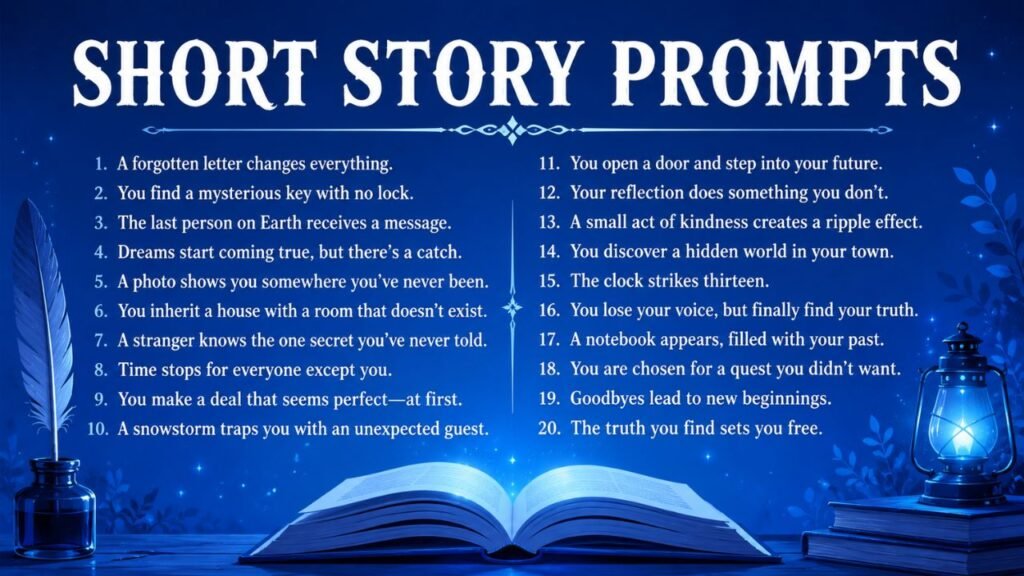
- A secret diary, something strange under the bed, and apple pie
- A lucky charm, a pair of binoculars, and the smell of cleaning products
- A small lie that keeps getting bigger around a campfire
- A fortune cookie that reads: “Run now. Say nothing. Your father is waiting.”
- A babysitter who finds a horrifying photograph while snooping
These minimalist prompts work especially well for flash fiction, where you’re aiming for emotional impact in under a thousand words rather than a fully mapped plot.
Fiction writing prompts
Broader fiction writing prompts give you more room to build a world, a cast, and a longer arc. They’re ideal when you’re not just filling a weekly slot but actually developing something you want to expand into a longer piece.
- A homeschooled boy vanishes, leaving only a short story he’d just printed
- A sixth-grade teacher disappears, replaced Monday by her husband with no explanation
- Identical twins, a party invitation, and a locked closet
- A character raised in a mansion who’s never been allowed outside
- A librarian who looks exactly like your character, only thirty years older
Example in practice: Start with the mystery element, then work backward to explain how your character discovered it. That structure almost always produces a stronger opening line.
Best Short Story Prompts for Genre Fiction
Genre gives a prompt its texture. The same bare-bones scenario can become a thriller, a romance, or straight comedy depending on how you frame it, so matching prompts to genre sharpens your voice fast.
| Genre | Sample Prompt | Tone to Aim For |
| Mystery | A crossword puzzle hides a coded message | Slow-burn suspense |
| Horror | A neighbor is louder than any human should be | Creeping dread |
| Romance | Two strangers keep bumping into each other on the sidewalk | Warm, hopeful |
| Sci-fi | Your emotions now control the weather | High-concept wonder |
| Comedy | A superhero lives two doors down and hates small talk | Light, absurd |
- Mystery prompts reward a slow reveal and unreliable narration
- Horror prompts thrive on suggestion rather than explicit detail
- Romance prompts need one small obstacle keeping characters apart
- Sci-fi prompts should introduce the rule of the world early
- Comedy prompts work best with a character who takes things too seriously
Short story prompts for adults
Short story prompts for adults often lean into moral ambiguity, complicated relationships, and consequences that don’t resolve neatly. That’s what separates them from lighter prompts aimed at younger writers.
- Your character is caught shoplifting, and the owner asks for a favor instead of calling police
- A character recently remarried, and their new spouse vanishes without warning
- A stranger follows your character, so they double back and start following the stranger
- Your character notices their new boss looks like the person who witnessed their parents’ murder
- A character believes they hear the voices of the dead through an old radio
These prompts tend to produce stronger fiction because the stakes feel earned rather than convenient. Give your character something to lose that actually matters to them, and the story writes itself from there.
How Do You Turn a Prompt Into a Finished Story?
A prompt is only the spark. Getting from that spark to a complete draft takes a bit of structure, even if the writing itself stays loose and instinctive.
- Write the ending first if the middle feels overwhelming
- Give your character one clear want, then block it immediately
- Set a word count goal before you start, even a rough one
- Draft messy and save the editing for a second pass entirely
- Finish anyway even if the prompt takes the story somewhere unplanned
Example in practice: Many writers find that committing to a fixed deadline, even a self-imposed one, is what actually turns a prompt into a finished piece rather than an abandoned file.
Daily and Weekly Writing Prompt Challenges
Structure keeps momentum alive. A daily or weekly challenge built around short story prompts gives you accountability without needing a writing group or formal class.
- Daily sprints of ten to fifteen minutes build consistency fast
- Weekly deadlines suit longer, more developed short stories
- Monthly themes let you group prompts around one genre or mood
- Public accountability, even a small one, boosts follow-through
- Tracking sheets help you see your progress across a full year
Committing to 52 stories in 52 weeks, one for every week of the year, is one of the most popular versions of this challenge, and it scales easily whether you’re brand new to fiction or a seasoned writer chasing a fresh habit.
Short Story Prompt Generators and Tools Worth Trying
If you burn through a written list quickly, a prompt generator can keep the ideas flowing indefinitely. These tools randomize objects, scenarios, and first lines so you’re never stuck twice with the same starting point.
| Tool Type | Best For | Output Style |
| Random word generators | Three-object prompts | Quick, playful |
| First-line generators | Instant scene drops | Dramatic, in medias res |
| Genre-specific generators | Focused practice | Tone-matched prompts |
| Photo-based prompts | Visual writers | Image-driven story starters |
- Bookmark a few generators so you always have a backup source
- Mix random and curated prompts to balance surprise with control
- Save prompts you skip since they might fit a future mood better
- Combine two generators’ outputs for a genuinely unique starting point
Happy Writing
At the end of the day, the goal isn’t a perfect story. It’s a finished one. Grab a hot drink, pick a prompt that makes you a little curious or a little nervous, and give yourself permission to write badly before you write well.
Fifty-two stories sounds ambitious until you break it into fifty-two single sittings. Some weeks will produce a story you’re proud of. Others will just be practice, and that’s fine too, because every draft sharpens the next one.
FAQs
What are short story prompts?
Short story prompts are starting points, like objects, scenarios, or first lines, meant to spark a complete piece of fiction.
How long should a short story from a prompt be?
Most short story prompts work well for pieces between 800 and 2,000 words, though flash fiction can run shorter.
Where can I find free short story prompts?
Writing blogs, generator tools, and community challenges all offer free short story prompts updated regularly throughout the year.
Are short story prompts good for beginners?
Yes, short story prompts are ideal for beginners since they remove the pressure of choosing a topic from scratch.
Can one prompt work for multiple genres?
Absolutely. The same short story prompts can become horror, romance, or comedy depending on tone and character choices.
How often should I use writing prompts?
Many writers use short story prompts weekly, though daily sprints work well for building a faster writing habit.
Do professional writers use prompts too?
Yes, plenty of published authors use short story prompts to break through blocks or explore ideas outside their usual genre.
Conclusion
Short story prompts turn a blank page into a manageable, even exciting, starting point. Whether you’re working through a full year of short story writing prompts or just need one idea to get unstuck today, the goal stays the same: sit down, pick a spark, and write.
Momentum builds through repetition, not perfection, and every finished draft, messy or not, makes the next one easier. Pick a prompt from this list, set a timer, and start your story today.

Alex Carter is a technology writer covering AI, software, cybersecurity, and digital trends, delivering expert insights and practical guides.